
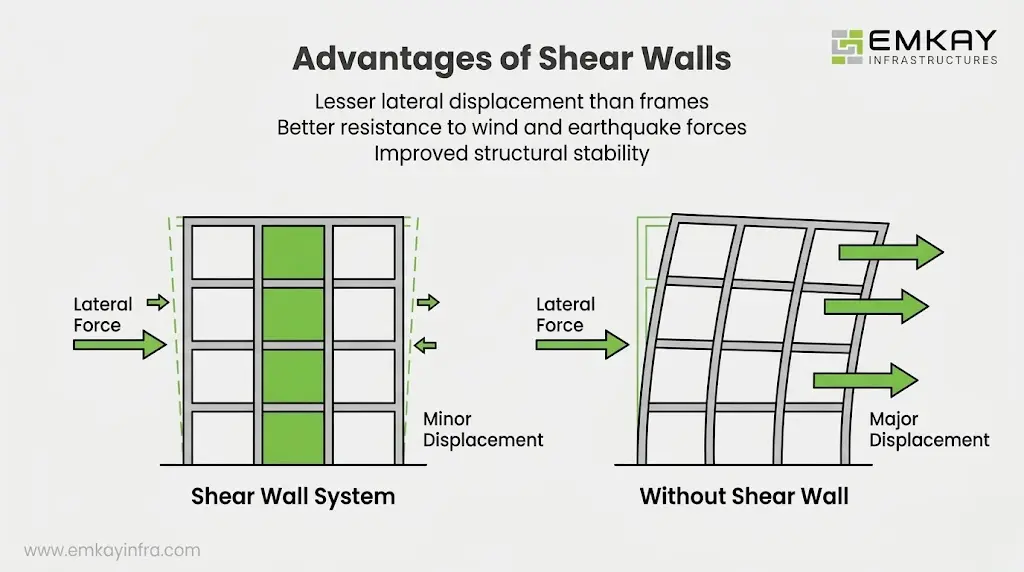
The main advantages of a shear wall include superior resistance to wind and earthquake forces, improved structural stability, faster construction timelines, fewer interior columns, lower long-term maintenance costs, and efficient load transfer to the foundation.
For modern residential and commercial buildings in Coimbatore and across Tamil Nadu, shear walls play a critical role in improving safety, durability, and usable space—especially in multi-storey construction.
Why Understanding Shear Wall Benefits Matters
During a recent project consultation in Coimbatore, a property developer asked:
“What am I actually getting for the extra cost of shear walls?”
That question reflects what most building owners, developers, and architects want—real performance value, not just theory.
Understanding what a shear wall is important, but understanding why it is used helps you make confident structural decisions.
Here are the 7 key advantages of shear walls in modern construction.
1. Superior Resistance to Lateral Forces (Wind & Earthquakes)
This is the primary engineering reason shear walls are used.
In conventional frame structures, lateral forces travel through multiple beams and columns, which can lead to:
- Movement between elements
- Stress concentration
- Higher deformation
Shear walls provide a stiff vertical element that transfers forces directly to the foundation, helping reduce movement and improve overall stability.
Why This Matters in Tamil Nadu
Even in moderate seismic zones, structural safety is important because:
- Wind loads on mid-rise buildings can be significant
- Soil conditions may require better lateral support
- Building codes require seismic-resistant design
Properly designed shear walls follow key Indian Standards:
- IS 1893 (Seismic Design)
- IS 13920 (Ductile Detailing)
- IS 456 (RCC Design)
2. More Open Floor Plans & Architectural Flexibility
Stronger structures don’t always mean more columns.
Traditional structures require multiple internal columns, which:
- Interrupt layouts
- Reduce usable space
- Limit design flexibility
Shear walls concentrate structural strength in specific areas like:
- Lift cores
- Staircases
- Perimeter walls
This allows:
- Larger open interiors
- Cleaner layouts
- Better space utilization
For developers, this often leads to improved property value and better buyer appeal.
3. Faster Construction Speed
Shear wall systems work well with modern formwork systems such as aluminium or modular formwork.
Because layouts repeat floor-to-floor:
- Formwork can be reused efficiently
- Setup time is reduced
- Construction cycles become faster
Typical Comparison
- Shear wall system: ~5–7 days per floor
- Traditional frame: ~10–14 days per floor
Faster construction can help reduce:
- Project timelines
- Labour costs
- Financing duration
4. Lower Long-Term Maintenance Costs
Buildings without proper lateral resistance may develop:
- Cracks in walls
- Leakage issues
- Misaligned doors and windows
Shear walls help control building movement, which can result in:
- Fewer visible cracks
- Reduced water infiltration
- Lower repair frequency
- Longer building lifespan
5. Better Drift Control
Lateral drift is the sideways movement of a building due to wind or seismic forces.
Excessive drift can cause:
- Discomfort for occupants
- Cracked finishes
- Door and window issues
Shear walls improve structural stiffness, helping reduce this movement and improving both safety and comfort.
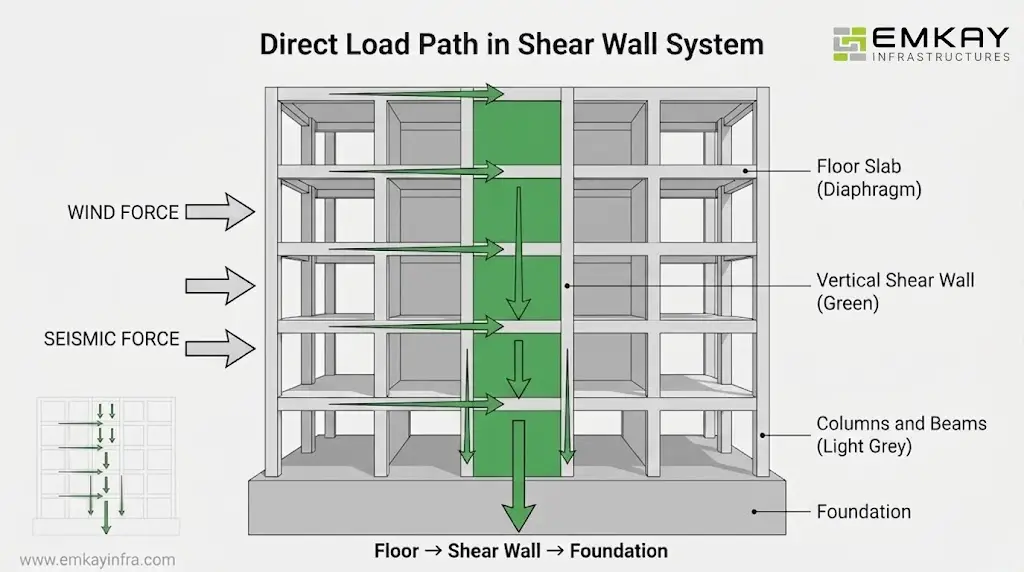
6. Direct Load Path to the Foundation
Shear walls create a simple and efficient load transfer system:
Floor → Shear Wall → Foundation
This direct path results in:
- Predictable structural behaviour
- Fewer weak points
- Better load distribution
- Improved reliability during stress
7. Protection of Overall Building Investment
A building includes more than just its structure:
- Electrical systems
- Plumbing
- Interiors
- Glass and finishes
All these elements are sensitive to structural movement.
With properly designed shear walls:
- Internal damage is minimised
- Repair costs are reduced
- Overall, building performance improves
Advantages of Shear Walls: Summary
| Advantage | Practical Benefit |
|---|---|
| Lateral Strength | Resists wind and seismic forces |
| Open Layouts | Fewer columns, more usable space |
| Faster Construction | Reduced project timelines |
| Low Maintenance | Fewer cracks and repairs |
| Drift Control | Better stability and comfort |
| Direct Load Path | Reliable structural behaviour |
How Emkay Infrastructure Delivers These Advantages
At Emkay Infrastructure, we design and execute reinforced concrete structural systems across Coimbatore and Tamil Nadu using engineering-driven methods.
Our Approach:
- Detailed structural analysis before construction
- Site-specific load path planning
- High-grade concrete testing (M25–M40)
- Precise reinforcement placement
- Modern formwork systems for faster execution
- Full compliance with Indian Standards
Our Experience:
- 5+ years in RCC construction
- Projects across Coimbatore, Tiruppur, and Erode
- Residential, commercial, and industrial structures
All structural recommendations are provided based on project-specific engineering analysis and relevant IS codes.
Key Takeaways
- Shear walls improve building stability and safety
- They help reduce structural movement and damage
- They enable faster construction and better space usage
- They are especially important for multi-storey buildings
📞 Ready to Build Safer, Stronger, Faster?
Planning a residential, commercial, or industrial project in Coimbatore or Tamil Nadu?
Get expert guidance on choosing the right structural system for your project.
👉 Book your free structural consultation today: 9345552010
What you’ll get:
- Preliminary structural consultation
- Site assessment guidance
- Structural system recommendations
- Cost and timeline insights
Written by the Structural Engineering Team – Emkay Infrastructure
Experts in shear wall construction, structural design, and RCC building solutions
Serving Coimbatore and across Tamil Nadu
Frequently Asked Questions About Shear Walls
2. What is the difference between shear wall and column structure?
Shear walls are continuous vertical elements designed to resist lateral forces like wind and earthquakes, while columns mainly carry vertical loads. Shear walls provide a direct and more stable load path to the foundation.
3. Where should shear walls be placed in a building?
Shear walls are typically placed in stair cores, lift shafts, perimeter walls, and structural centers. Proper placement ensures balanced load distribution and better resistance to lateral forces.
4. How long do shear walls last compared to regular walls?
When properly designed and constructed, shear walls can perform effectively for the entire lifespan of a building. Their ability to reduce movement helps minimize cracks and long-term structural issues.
5. Can shear walls be used in basement construction?
Yes, shear walls are commonly used in basements. They help resist soil pressure and provide additional structural stability when designed with proper waterproofing and reinforcement.
6. What are the disadvantages of shear wall construction?
Shear walls may increase initial construction cost and require careful planning during design. Post-construction modifications can also be more difficult compared to traditional structures.
7. Do shear walls need special foundations?
Yes, shear walls transfer significant loads directly to the ground, so foundations must be properly designed to handle both vertical and lateral forces as per structural standards.
8. What is the typical thickness of a shear wall?
Shear wall thickness usually ranges between 150 mm and 300 mm, depending on building height, load requirements, and structural design.
9. Can doors and windows be provided in shear walls?
Yes, openings can be included, but they must be planned during design and properly reinforced to maintain structural strength and performance.
10. Are shear walls suitable for residential buildings?
Yes, shear walls are widely used in residential buildings, especially multi-storey apartments. They improve stability, allow better space utilization, and enhance overall structural safety.