
A shear wall and a normal wall may look similar, but they perform completely different structural roles. A normal wall divides space or carries vertical loads, while a shear wall is engineered to resist sideways forces such as wind and earthquakes and transfer them safely to the foundation. The difference lies in their structural function, reinforcement, placement, and load-handling capability, not their appearance.
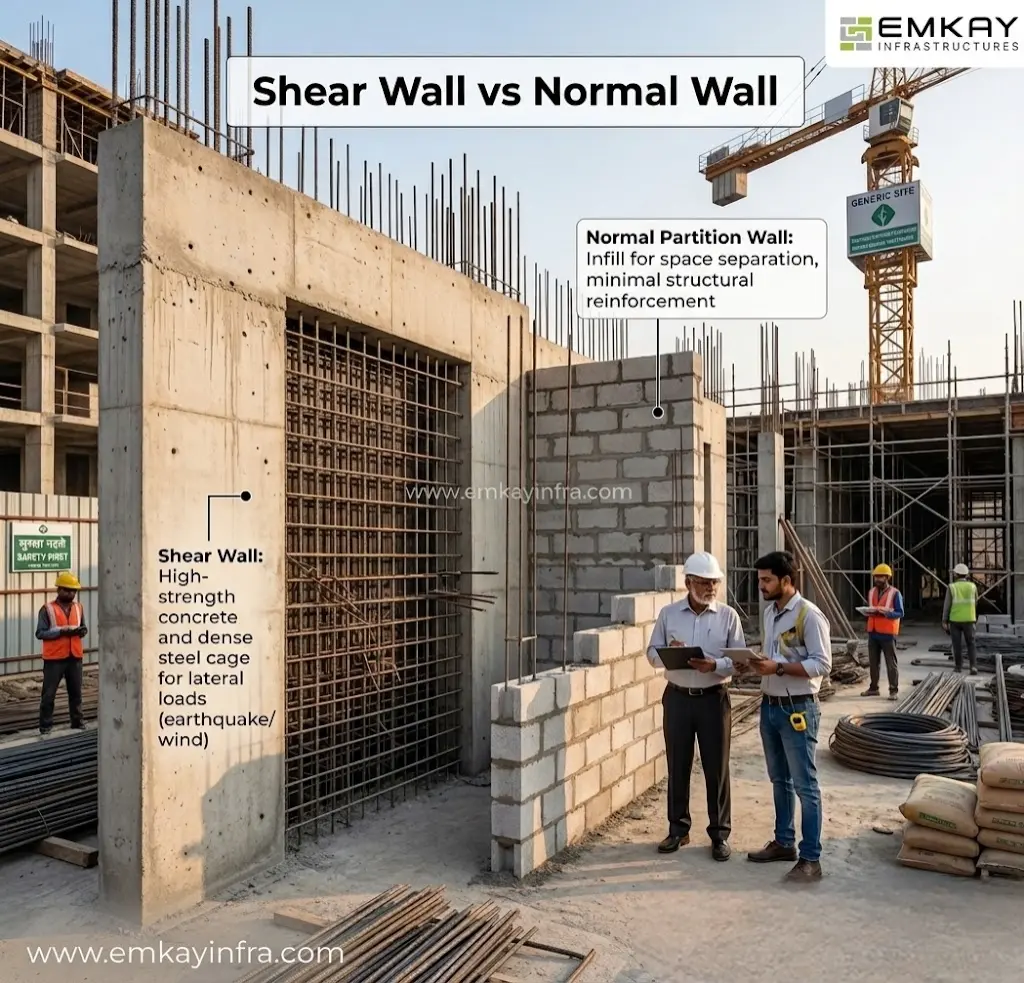
The Most Dangerous Assumption in Construction
One of the most common mistakes we see on renovation and construction sites across Coimbatore and throughout Tamil Nadu is assuming all concrete walls serve the same purpose.
A wall may look thick and strong, but removing the wrong wall can compromise the entire structure. Damage often does not appear immediately. Instead, warning signs such as diagonal cracks, slab movement, or misaligned doors may appear months later after environmental stress.
The most dangerous assumption is this: if a wall looks solid, it must be structural and safe to modify. That assumption is often incorrect.
What Is a Normal Wall?
In reinforced concrete buildings, several wall types are considered normal (non-shear) walls:
Partition Walls
Used only to divide rooms. They carry no structural load and can often be removed safely after confirmation.
Load-Bearing Walls (Vertical Only)
Support vertical loads from slabs and roofs, but are not designed to resist lateral forces.
Boundary Walls
Define property limits and carry only their own weight.
Brick Infill Walls
Installed between beams and columns after structural framing. These are not part of the building’s lateral resistance system.
What Makes a Shear Wall Fundamentally Different?
1. Purpose
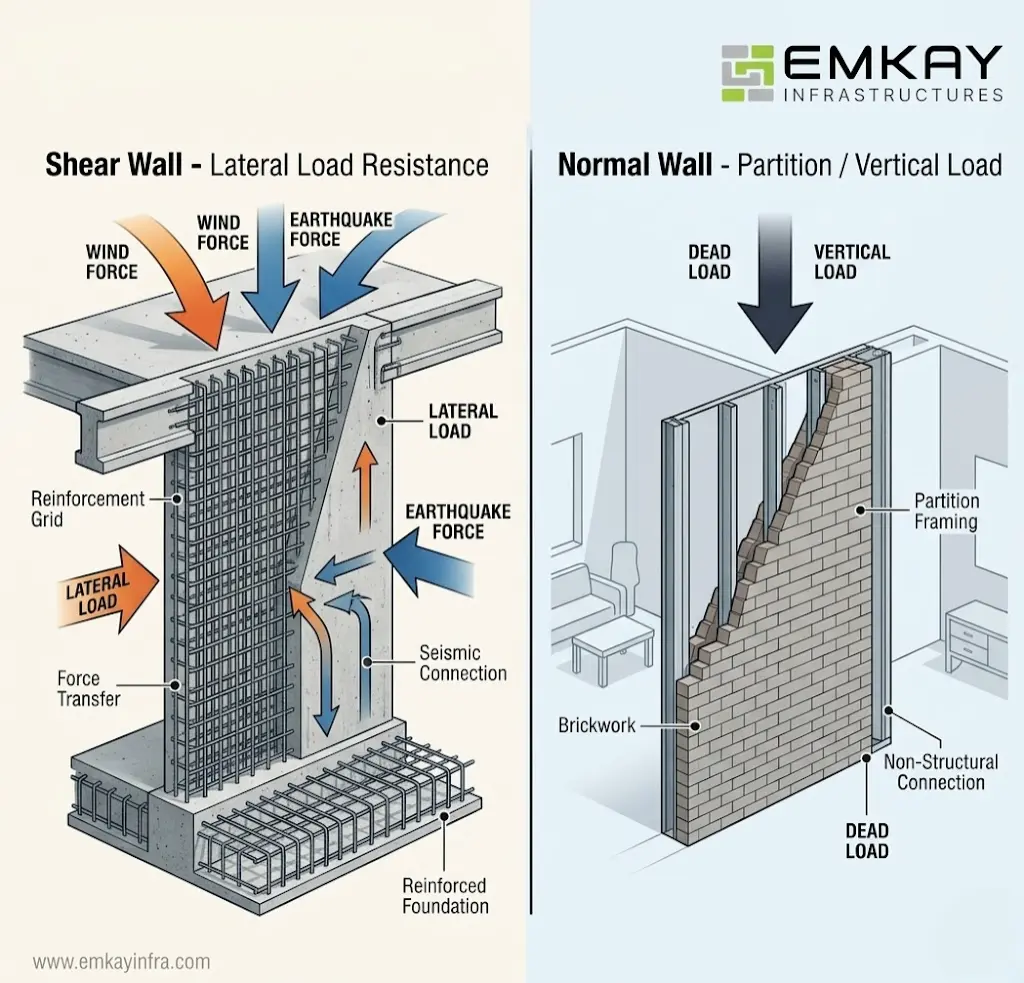
A shear wall resists lateral forces.
Normal walls mainly handle vertical loads or divide spaces.
Columns hold a building up. Shear walls keep it stable when external forces push sideways.
2. Reinforcement
Shear walls contain carefully calculated steel reinforcement grids designed based on:
- building height
- wind zone
- seismic zone
- load path distribution
Normal walls typically contain minimal or no structural reinforcement.
3. Structural Integration
Shear walls are fully integrated into the building’s structural system and connect directly with:
- slabs
- beams
- columns
- foundation
This continuous load path allows them to safely transfer forces. Partition or infill walls are not connected in this way.
4. Placement Logic
Shear wall placement is determined through engineering analysis, not convenience.
Typical locations include:
- lift cores
- stair shafts
- structural centers
- perimeter balancing points
5. Behaviour Under Load
Under lateral forces:
Shear wall: bends gradually and absorbs energy
Normal wall: cracks suddenly and fails
This controlled ductile behaviour is required by Indian Standard IS 13920 for seismic-resistant structures.
Side-by-Side Comparison
| Feature | Shear Wall | Normal Wall |
| Function | Resists lateral forces | Divides space or carries vertical load |
| Loads handled | Wind and seismic | Gravity only |
| Reinforcement | Heavy engineered steel | Minimal or none |
| Connection | Fully structural | Non-structural |
| Placement | Engineer determined | Architect determined |
| Failure mode | Controlled | Brittle |
| Removable | No | Sometimes |
Myth: Thick Wall = Shear Wall
Wall thickness does not determine whether a wall is structural.
A thick concrete wall can still be non-structural.
A properly engineered shear wall can be thinner yet far stronger.
Only structural drawings or a professional structural assessment can confirm whether a wall is a shear wall.
Can You Identify a Shear Wall Just by Looking?
No. Finished walls can appear identical.
Possible indicators (not confirmation):
- located near lift or stair cores
- runs continuously through the floors
- appears in the same location on every level
The only reliable method is reviewing structural drawings.
Why This Distinction Matters During Renovation
Most structural mistakes occur during renovation, not new construction.
Before planning an open kitchen layout or combining two rooms, a structural audit is mandatory to identify hidden shear walls.
In new projects, engineers design shear walls as part of a complete system. During renovation, walls may be removed without understanding their structural role.
We have assessed buildings where a wall was removed, and structural symptoms appeared more than a year later after environmental exposure. By then, corrective work becomes complex and costly.
Rule: Never remove a wall until a structural engineer confirms its function.
How Emkay Infrastructure Approaches Structural Wall Systems
At Emkay Infrastructure, we design and construct reinforced concrete shear wall systems across Coimbatore and Tamil Nadu using engineering-driven methods:
- detailed load path analysis
- high-grade concrete testing (M25–M40)
- on-site casting using engineered formwork
- full integration with slabs and foundations
- compliance with IS 456, IS 13920, and safety standards
Early collaboration between structural engineers and architects ensures proper wall placement without compromising design flexibility.
Key Takeaways
- Shear walls and normal walls serve completely different structural roles.
- Appearance cannot reliably identify a shear wall.
- Shear walls resist lateral forces; normal walls usually do not.
- Removing a shear wall can weaken the entire building.
- Structural drawings are the only reliable identification method.
- Proper shear wall design improves building safety and lifespan.
Final Thoughts
Shear walls and normal walls may appear identical, but their engineering roles are fundamentally different. The distinction lies in reinforcement, placement, and structural integration.
Understanding this difference is essential for anyone planning construction or renovation. When structural safety is involved, assumptions are risky. Verification is always necessary.
📞 Planning a renovation or construction project? Don’t risk structural damage.
Before removing or modifying any wall, get expert guidance to ensure your building’s safety and stability.
👉 Book your free structural consultation today: 9345552010
Written by the Structural Engineering Team – Emkay Infrastructures
Experts in shear wall construction, structural design, and RCC building solutions
5+ years of experience across residential, commercial, and industrial projects in Coimbatore and Tamil Nadu
Frequently Asked Questions
Is a shear wall the same as a load-bearing wall?
No. A load-bearing wall supports vertical loads (weight of the building), while a shear wall resists horizontal forces. Some walls can perform both functions, but they are not the same.
Where are shear walls used in buildings?
Shear walls are usually placed on exterior walls or around staircases and lift cores. They are positioned symmetrically to balance the building and improve structural strength.
Can shear walls have windows and doors?
Yes, but openings reduce strength. Engineers use reinforcement techniques to maintain structural integrity when adding doors or windows.
What materials are used for shear walls?
Common materials include reinforced concrete, steel, plywood, and concrete blocks. The choice depends on building type, cost, and location.
Do all buildings need shear walls?
Not all buildings require shear walls, but most modern structures include them for safety, especially in earthquake-prone or high-wind areas.
Can you remove a shear wall during renovation?
Yes, but only with proper structural planning. Removing a shear wall without replacement can weaken the building and cause serious safety risks.
How thick is a shear wall?
Shear wall thickness varies based on design and materials, typically ranging from 140mm to 500mm in concrete structures.
What happens without shear walls during earthquakes?
Buildings without shear walls can collapse or suffer severe damage because they cannot resist lateral forces effectively.