
A shear wall is a reinforced concrete structural wall designed to resist lateral forces such as wind and earthquakes. It stabilizes buildings, prevents structural damage, and safely transfers loads to the foundation. In multi-storey and high-rise construction, shear walls are essential safety components that protect structural stability throughout a building’s lifespan.
Understanding Shear Walls in Real Construction Terms
In practical construction, columns and beams support vertical loads, but they alone cannot protect a building from lateral forces. Wind pressure, seismic activity, and dynamic structural loads create horizontal stress that can cause movement or instability. A shear wall is specifically engineered to resist that movement and maintain structural balance.
At Emkay Infrastructures, we install reinforced concrete shear walls across Coimbatore and throughout Tamil Nadu for residential, commercial, and industrial projects. From our field experience, buildings constructed with properly designed shear wall systems consistently perform better long-term than structures relying only on conventional framing.
What Exactly Is a Shear Wall?
A shear wall is a vertical reinforced concrete structural element designed to resist lateral loads and transfer them safely to the foundation. These loads typically come from:
- Wind pressure acting on building surfaces
- Seismic ground movement
- Machinery vibration in industrial structures
- Heavy dynamic structural forces
The term shear refers to forces attempting to slide one part of a structure past another. Shear walls are engineered specifically to resist this motion and preserve structural integrity.
How Shear Walls Work Structurally
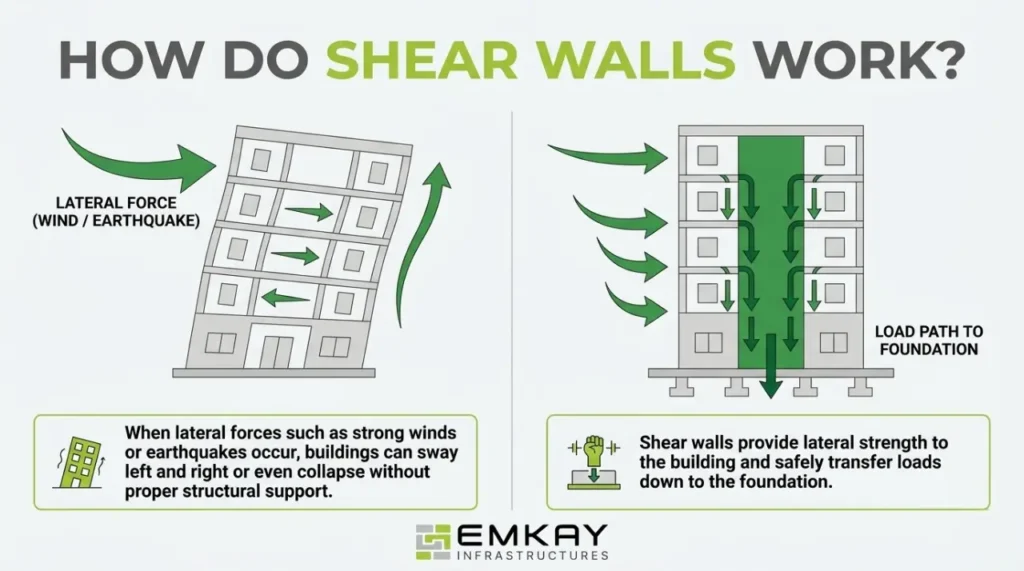
Shear walls perform three essential structural functions.
1. Absorbing Lateral Force
When wind or seismic forces act on a building, loads travel through floor slabs into the shear walls. Because these walls are stiff and reinforced, they resist deformation that could otherwise compromise stability.
2. Transferring Load to the Foundation
Correct load path design is critical. Our engineering team performs detailed structural analysis to ensure forces transfer safely from upper floors down to the raft foundation without discontinuity.
3. Controlling Building Sway
In tall structures, lateral drift must remain within safe limits defined by engineering codes. Shear walls reduce sway and vibration, improving safety, structural durability, and occupant comfort.
Materials Used in Shear Wall Construction
High-Grade Concrete
Shear walls require concrete that meets specified compressive strength standards, typically ranging from M25 to M40, depending on building design. Material testing is performed before casting to verify strength compliance.
Steel Reinforcement
Concrete is strong in compression but weak in tension. Reinforcement bars inside the wall handle tensile stresses generated during wind or seismic loading.
Formwork Precision
Formwork accuracy directly affects structural performance. We use engineered formwork systems during casting to maintain dimensional precision, smooth surface finish, and consistent structural quality.
Why Shear Walls Are So Important
Prevent Structural Failure
Buildings without sufficient lateral resistance are vulnerable during storms or earthquakes. A common structural issue engineers investigate is soft-storey failure, where one floor shifts relative to others. Properly designed shear walls prevent this condition.
Protect Building Systems
Structural movement damages more than concrete. It can affect plumbing systems, electrical conduits, glazing, and facade panels. Stable buildings reduce repair costs across all components.
Required by Engineering Standards
Indian Standards such as IS 456 and IS 13920 define requirements for earthquake-resistant structural design. These codes are based on real structural failure analysis and must be followed during planning and execution.
Reduce Long-Term Maintenance
From real project observations, buildings with strong lateral systems show fewer cracks, reduced structural stress, and lower maintenance expenses over time.
Where Shear Walls Are Placed in a Building
Placement is determined by engineering analysis, not convenience. Common locations include:
- Lift cores and stair shafts
- Building perimeter zones
- Balanced intervals across floor plans
- Continuous vertical alignment from roof to foundation
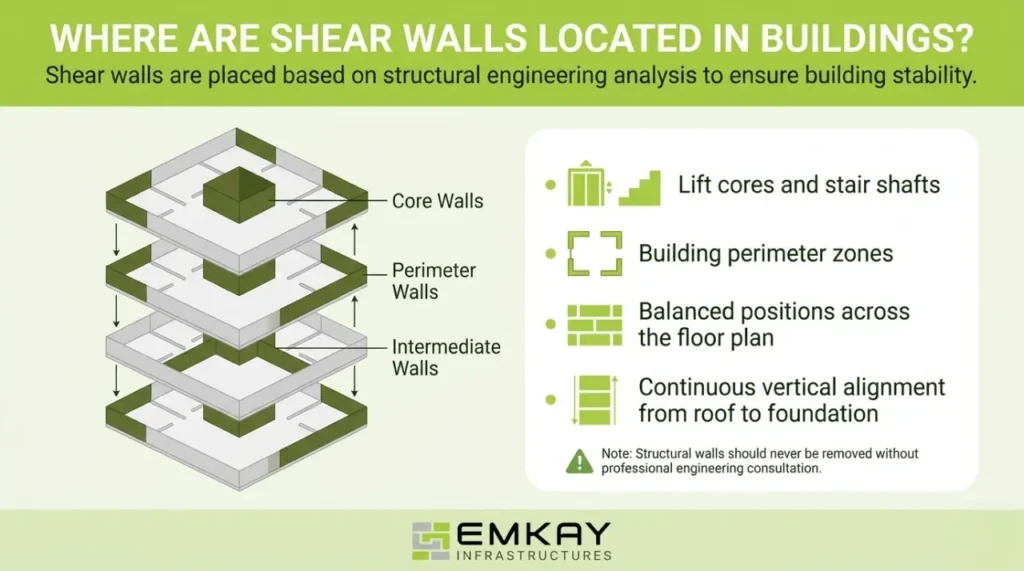
During renovation inspections, we occasionally encounter situations where a wall removed for space planning turns out to be structural. This can create serious safety risks. Structural consultation is always required before removing any wall.
Special Considerations for High-Rise Buildings
Tall structures behave very differently from low-rise buildings and require specialized structural design.
Overturning Forces
As height increases, lateral forces generate large overturning moments at the base. Shear walls must be engineered to resist these forces safely.
Structural Integration
Shear walls must connect properly with beams, slabs, and columns. Floor slabs act as diaphragms that transfer loads to the walls. Weak connections reduce performance.
Foundation Coordination
Shear wall loads must be distributed safely into the ground. Foundation design is coordinated carefully so structural forces are balanced and safely transferred.
Practical Questions Clients Often Ask
Can any wall act as a shear wall?
No. Only walls designed with proper thickness, reinforcement, and placement can function as shear walls.
Are shear walls needed outside earthquake zones?
Yes. Wind loads alone can generate significant lateral forces in tall buildings.
Will shear walls affect the design layout?
They may influence planning, but early collaboration between architects and structural engineers allows layouts to remain efficient while maintaining strength.
Do shear walls increase cost?
They increase initial structural cost slightly, but reduce long-term repair, maintenance, and structural risk expenses. Over a building’s lifecycle, they are cost-effective.
Warning Signs of Weak Lateral Stability
During structural inspections, these signs may indicate insufficient lateral resistance:
- Diagonal cracks near windows or doors
- Cracks at slab-wall junctions
- Misaligned doors after storms
- Visible structural tilt
- Repeated facade damage
Any of these should be evaluated by a structural engineer immediately.
How Emkay Infrastructures Executes Shear Wall Projects
Our construction approach combines engineering precision, material quality, and controlled execution:
- Detailed lateral load analysis before construction
- Concrete casting using engineered formwork systems
- High-grade concrete tested for strength compliance
- Structural integration with slabs, beams, and columns
- Foundation preparation aligned with load demands
- Compliance with safety standards and building regulations
We also coordinate with architects to position shear walls where they maximize structural strength without compromising design functionality.
Key Takeaways
- A shear wall is a reinforced structural wall designed to resist lateral forces.
- It prevents sway, cracking, and structural damage.
- Shear walls transfer loads safely to foundations.
- They are essential for multi-storey and high-rise construction.
- Correct placement and engineering design are critical.
- Buildings without proper shear walls are structurally vulnerable.
- They reduce maintenance costs and increase lifespan.
- Structural consultation is required before removing any wall.
Final Thoughts
Shear walls are one of the most critical structural components in modern construction. They stabilize buildings, increase durability, protect against environmental forces, and reduce long-term repair costs. In any multi-storey or heavy-load structure, they are a core engineering requirement rather than an optional feature.
For projects where safety, longevity, and structural performance matter, proper shear wall design and execution make a measurable difference.
If you’re planning a new construction project or structural renovation, getting expert guidance early can prevent costly mistakes and ensure your building is structurally safe.
📞 Book your free consultation today: 9345552010
Written by the Structural Engineering Team – Emkay Infrastructures
5+ years of experience in residential, commercial, and industrial construction projects across Tamil Nadu.
Frequently Asked Questions
Are shear walls required for small buildings?
Small single-storey buildings may not require them, but multi-storey structures usually do.
How thick is a shear wall?
Thickness varies based on height and loads, determined through engineering calculations.
Can a shear wall be removed?
No. Removing one without structural analysis can weaken the building.
What materials are used?
Typically reinforced concrete with high-grade concrete mixes and steel reinforcement.
Where are shear walls located?
Usually around lift cores, staircases, perimeters, or structural centers.