
Construction in Coimbatore and Tamil Nadu is moving faster than ever — RERA timelines are tighter, labor costs are rising, and demand for monolithic and shear wall structures is growing. The formwork system you choose directly affects your project’s speed, cost, quality, and profit. This guide gives you a clear, numbers-backed comparison of plastic formwork vs timber formwork so you can make the right call before work begins.
What is timber formwork?
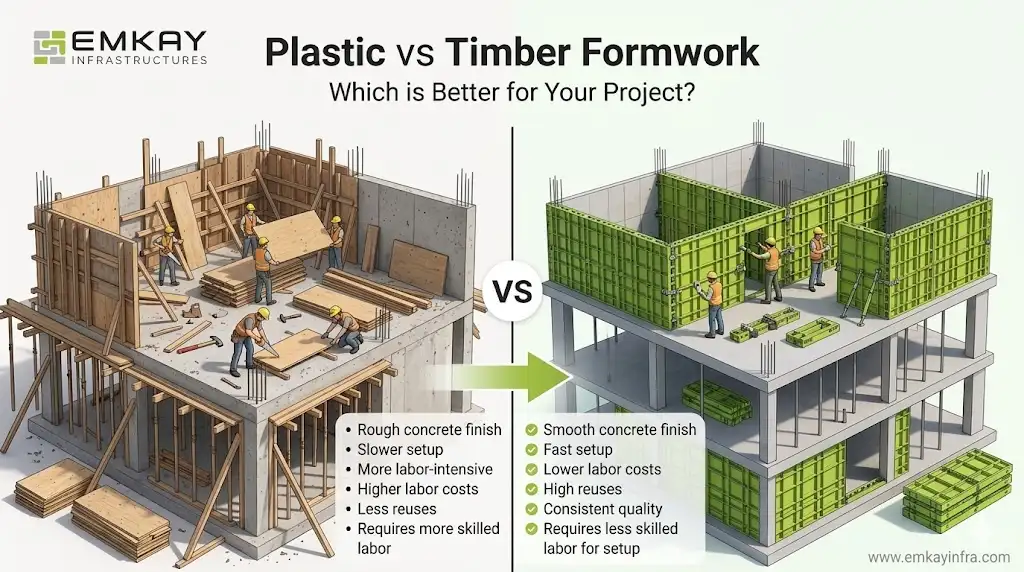
Timber formwork uses wooden planks or plywood sheets (typically 12–18 mm thick) held in position by props and wooden supports to shape fresh concrete. It has been the standard method for decades, and carpenters across India are highly familiar with it. For small residential work, individual house construction, and structures with complex or irregular shapes, timber remains a practical choice because it is easy to cut and modify on site.
The core limitation is durability. A typical plywood sheet used in site formwork survives 5–10 pours before the surface degrades enough to affect concrete finish or structural reliability. This means frequent replacement, ongoing material cost, and significant waste on larger projects. Timber also absorbs moisture, which causes swelling and warping — a serious problem during Tamil Nadu’s monsoon season and in coastal districts.
What is plastic formwork?
Plastic formwork systems use high-strength ABS or polypropylene panels with a modular, interlocking design. Panels are lightweight (typically 10–18 kg per sq m), require no nails, and connect using a pin-and-wedge or clip mechanism that semi-skilled workers can learn quickly. The non-porous plastic surface releases cleanly from cured concrete, leaving a smooth finish that often eliminates the need for plastering.
Plastic formwork is best suited to repetitive construction — apartment buildings, row houses, villas, and commercial floors — where the same panel sizes are reused across multiple floors or units. Each panel can typically be reused 50–100 times, meaning the upfront investment is spread across the entire project rather than charged floor by floor.
Plastic formwork vs timber formwork: full comparison
| Factor | Plastic formwork | Timber formwork |
|---|---|---|
| Reuse cycles | 50–100+ times | 5–10 times |
| Initial cost (India) | ₹450–₹700 per sq ft | ₹250–₹400 per sq ft |
| Cost per use | Low (amortised) | High (frequent replacement) |
| Panel weight | 10–18 kg / sq m | 20–30 kg / sq m |
| Concrete finish | Smooth — often no plaster needed | Rough — plastering required |
| Labor type | Semi-skilled, fewer workers | Skilled carpenters required |
| Cycle time per floor | 5–7 days | 10–14 days |
| Weather resistance | Waterproof, no warping | Swells in rain, warps in heat |
| Construction waste | Minimal | High — plywood offcuts and off-spec pieces |
| Custom / irregular shapes | Limited flexibility | Highly adaptable |
| Shear wall compatibility | Excellent — modular alignment | Adequate for small-scale |
| Site safety | No nails, lightweight handling | Nails, sharp edges, heavier loads |
| Environmental impact | Recyclable, less deforestation | Wood use, waste disposal issues |
1. Cost and long-term return on investment
Timber appears cheaper at first glance — roughly ₹250–₹400 per sq ft versus ₹450–₹700 per sq ft for plastic. But this comparison only holds for a single use. On a 10-floor apartment project, timber formwork typically needs to be replaced or heavily repaired 5–6 times across the project. Each replacement means new material purchase, carpenter time for recutting, and disposal of damaged plywood.
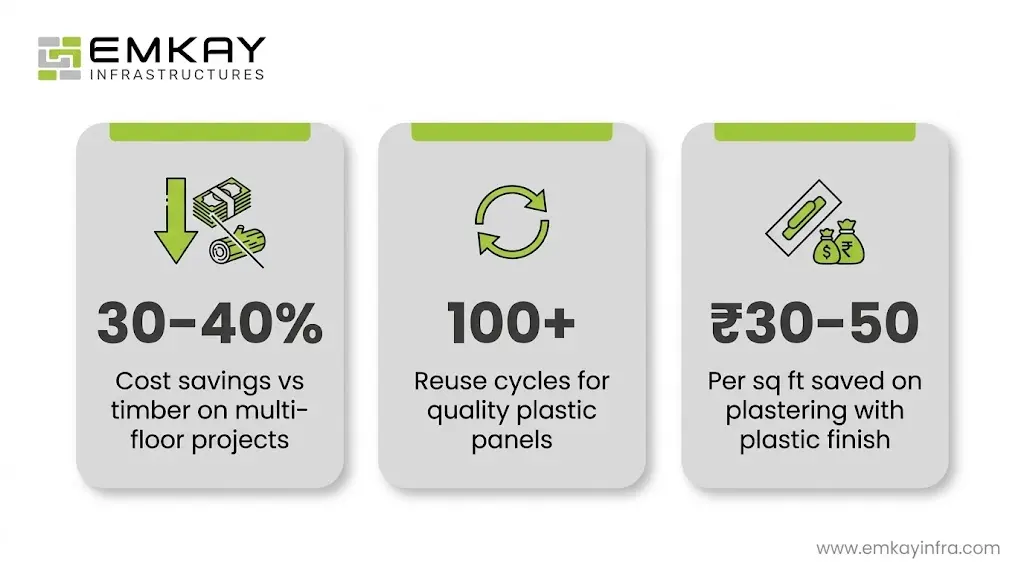
Plastic formwork, used across all 10 floors with the same panels, amortises its cost over the entire project. Our calculations on completed projects in Coimbatore show that plastic formwork becomes 30–40% more cost-efficient than timber over a multi-storey build when total material, labor, and finishing costs are counted together.
2. Construction speed and project timeline
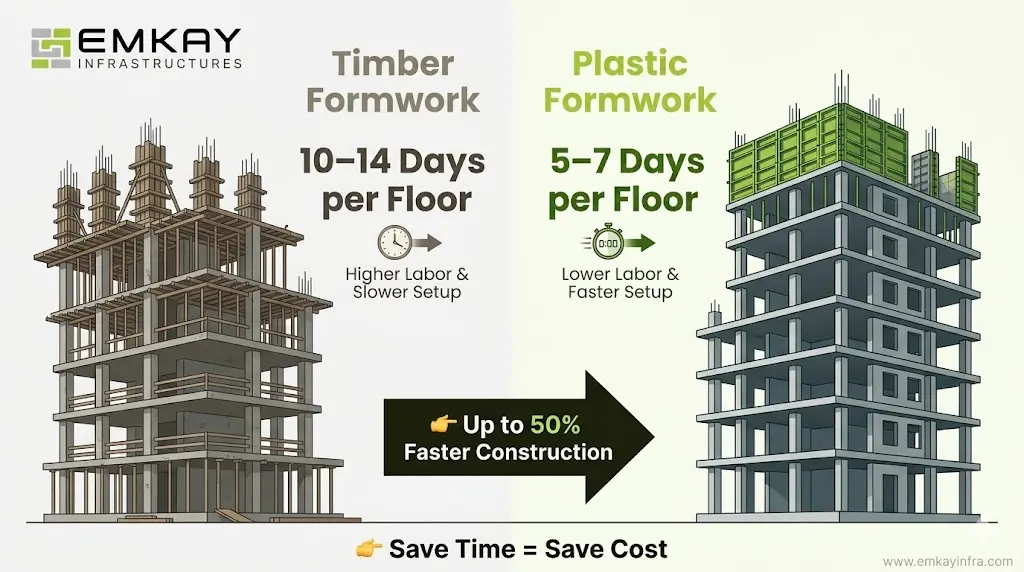
Timber formwork is slow because it is custom-built on-site. Carpenters must cut, fit, fix, and strip panels for each pour — a process that adds variability and depends heavily on crew skill and availability. Typical cycle time for a floor slab and walls using timber formwork is 10–14 days in standard residential conditions.
Plastic formwork panels arrive pre-sized and simply lock together. Assembly is systematic and repeatable, so teams get faster with each floor. Typical cycle time drops to 5–7 days per floor — roughly half the time. For a 10-floor building, this translates to approximately 60–70 days of slab-and-wall work compared to 120 days using timber, a potential 40–50% reduction in project duration. Under RERA timelines, that difference is significant for both compliance and handover commitments.
Real-world example (Coimbatore, G+5 apartment): Switching from timber to plastic formwork on a six-floor project reduced the structural completion timeline from 14 months to approximately 9 months, primarily through faster floor cycle times and reduced rework from uneven shuttering.
3. Concrete surface finish quality
Timber and plywood absorb water from fresh concrete. This causes surface voids, grain impressions, and an uneven texture that almost always requires plastering before paint or tiles can be applied. The cost of plastering on a mid-size apartment project in Tamil Nadu typically runs ₹30–₹50 per sq ft — a substantial hidden cost not visible in the formwork budget.
Plastic formwork’s non-porous surface produces a smooth, consistent concrete finish with minimal honeycombing. In many cases, the concrete surface can go directly to wall putty and paint without plastering, particularly for internal walls and ceilings. This is a meaningful quality and cost advantage in modern apartment construction where buyers expect even wall surfaces.
4. Labor requirements and availability
Skilled carpenter availability is one of the most constrained resources in Tamil Nadu’s construction sector. Timber formwork depends entirely on these workers for cutting panels to size, erecting supports, maintaining alignment during pour, and careful dismantling to preserve material for the next use. A typical floor using timber formwork requires 8–10 skilled workers.
Plastic formwork’s modular interlocking system can be handled by semi-skilled workers with 1–2 days of training. The panels snap together in a defined sequence, reducing the scope for alignment errors and allowing a floor to be managed by 4–5 workers. This 40–50% reduction in crew size has a direct impact on weekly labor cost and makes scheduling more predictable across the project.
5. Durability in Tamil Nadu’s climate
Tamil Nadu’s climate presents real challenges for timber formwork. Monsoon rains swell plywood sheets, breaking glue bonds and causing panels to deform. Summer heat causes rapid drying that cracks and warps timber, particularly if panels are stored outdoors between uses. The result is accelerated degradation — what might last 10 uses in a dry climate may last only 4–6 uses in Coimbatore or coastal districts.
Plastic formwork is waterproof and dimensionally stable across the temperature and humidity range typical in Tamil Nadu. Panels do not swell, warp, or degrade from moisture exposure, and they perform consistently whether the pour happens in February or August. This weather resistance is one reason plastic formwork has been adopted quickly in Kerala and coastal Tamil Nadu, where monsoon-related shuttering failures were a recurring problem with timber systems.
6. Site safety
Timber formwork sites carry inherent hazards: exposed nails in discarded plywood, sharp edges on cut panels, and the physical strain of handling heavy sheets at height. These risks compound on multi-storey work where panels are passed between floors. Plastic formwork eliminates nails, reduces individual panel weight, and the interlocking system means workers handle components predictably rather than wrestling with bespoke timber assemblies. Safer sites also reduce insurance exposure and regulatory risk under India’s Building and Other Construction Workers (BOCW) framework.
7. Environmental impact and sustainability
Construction is one of India’s largest sources of solid waste, and timber formwork is a significant contributor. Plywood used in formwork cannot typically be recycled due to the adhesives used in its manufacture — it goes to landfill or is burned on site. The volume of waste generated on a 10-floor timber-formwork project can run to several tonnes of degraded plywood.
Plastic formwork panels, by contrast, generate minimal site waste. At the end of life, ABS and polypropylene panels can be recycled. The reduction in timber use also reduces pressure on forest resources — an increasingly important consideration as green building certifications (IGBC, GRIHA) become more common in Tamil Nadu’s commercial real estate market.
Construction speed comparison between plastic formwork and timber formwork, showing 5 to 7 days vs 10 to 14 days per floor, with faster project completion
Which formwork system should you choose?
The right choice depends on your project type, timeline, and budget structure. Use this framework to decide:
Choose plastic formwork if:
- Multi-storey residential or commercial building (G+3 and above)
- Repetitive floor plans (apartments, row houses, villas)
- RERA-driven delivery timeline
- Monolithic or shear wall construction
- You want a better concrete finish without plastering cost
- Labor availability is a constraint on your site
Choose timber formwork if:
- Individual house (G or G+1) construction
- One-time or pilot project with no repeat floors
- Complex or highly irregular structural shapes
- Very tight upfront cash flow with no repeat use planned
| Project type | Recommended system | Reason |
|---|---|---|
| Individual house (G or G+1) | Timber | Low reuse need, custom sizes likely |
| Villas (multiple units) | Plastic | Repetitive layout, fast turnover |
| Apartment building (G+3+) | Plastic | High reuse, speed and finish advantages |
| Commercial building | Plastic | Timeline pressure, finish quality matters |
| Shear wall structure | Plastic | Alignment precision required |
Final verdict
Timber formwork remains a valid option for small, custom, or one-off projects where flexibility matters more than speed. But for the majority of residential and commercial construction happening in Coimbatore and Tamil Nadu today — apartments, villas, row houses, shear wall buildings — plastic formwork is the clearly superior system. It is faster, produces better concrete quality, requires less skilled labor, and becomes significantly cheaper over a full project lifecycle despite the higher initial outlay.
If your goal is to deliver projects faster, at higher quality, and with better profitability, plastic formwork is the right investment.
→ Read next: Plastic Formwork Systems: Complete Guide to Modern Construction in India
→ Read next: What Is a Shear Wall and Why Is It Important?
→ Read next: Shear Wall vs Normal Wall — Structural Differences Explained
📞 Ready to Build Safer, Stronger, Faster?
Planning a residential, commercial, or industrial project in Tamil Nadu?
Get expert guidance on choosing the right structural system for your project.
👉 Book your free structural consultation today: 9345552010
What you’ll get:
- Preliminary structural consultation
- Site assessment guidance
- Structural system recommendations
- Cost and timeline insights
Written by the Structural Engineering Team – Emkay Infrastructure
Experts in shear wall construction, structural design, and RCC building solutions
Serving Coimbatore and across Tamil Nadu
Frequently asked questions
Is plastic formwork expensive?
Plastic formwork has a higher initial cost (₹450–₹700 per sq ft) compared to timber (₹250–₹400 per sq ft), but it becomes 30–40% cheaper over a multi-storey project because of its 50–100+ reuse cycles and the savings on plastering and labor.
How many times can plastic formwork be reused?
Quality plastic formwork panels can be reused 50–100+ times depending on the brand, maintenance, and site conditions. With proper cleaning and storage, a good set of panels can serve an entire multi-floor project and beyond.
Does plastic formwork need skilled labor?
No. Plastic formwork uses an interlocking pin-and-wedge system that semi-skilled workers can assemble with basic training. Timber formwork requires experienced carpenters for cutting, fixing, and dismantling — a resource that is increasingly scarce and expensive in Tamil Nadu.
Is plastic formwork suitable for the Tamil Nadu climate?
Yes. Plastic formwork is waterproof and weather-resistant, performing well in Tamil Nadu's humidity, heat, and monsoon rains. Timber formwork warps and swells under these conditions, degrading faster and producing uneven concrete surfaces.
What maintenance does plastic formwork require?
Minimal maintenance. After each pour, clean panels with water, inspect for cracks or deformation, and store flat away from prolonged direct sunlight. Concrete does not adhere to plastic surfaces, so cleaning is straightforward.
Can plastic formwork be used for shear walls?
Yes. Plastic formwork is ideal for monolithic construction and shear walls. Its modular interlocking panels maintain precise alignment, which is critical for shear wall structural performance in multi-storey buildings.
Is plastic formwork eco-friendly?
Yes. Plastic formwork reduces timber consumption, generates significantly less construction waste than plywood, and can be recycled at the end of life. It supports green building objectives under IGBC and GRIHA certification frameworks.