
Introduction
Modern construction demands methods that deliver speed, efficiency, and sustainability. Builders and developers across India now seek innovative solutions that outperform traditional techniques.
For decades, the industry relied on timber and steel formwork. However, these conventional methods demand extensive labor, consume more time, and require frequent maintenance. Consequently, construction professionals are making a decisive shift toward advanced alternatives.
Plastic shuttering represents a game-changing solution that accelerates project timelines, minimizes material waste, and enhances structural quality. This comprehensive guide explores how these innovative molding systems work, their competitive advantages, practical applications, and the reasons behind their growing adoption throughout the Indian construction sector.
What Are Plastic Formwork Systems?
These construction solutions utilize high-strength plastic panels that shape and support concrete during the curing process.
The panels function as temporary molds, securing freshly poured concrete until it achieves sufficient strength. Unlike conventional materials, they offer distinct advantages:
- Lightweight design enables easier handling
- Simple assembly reduces installation complexity
- Multiple reuse cycles enhance cost-effectiveness
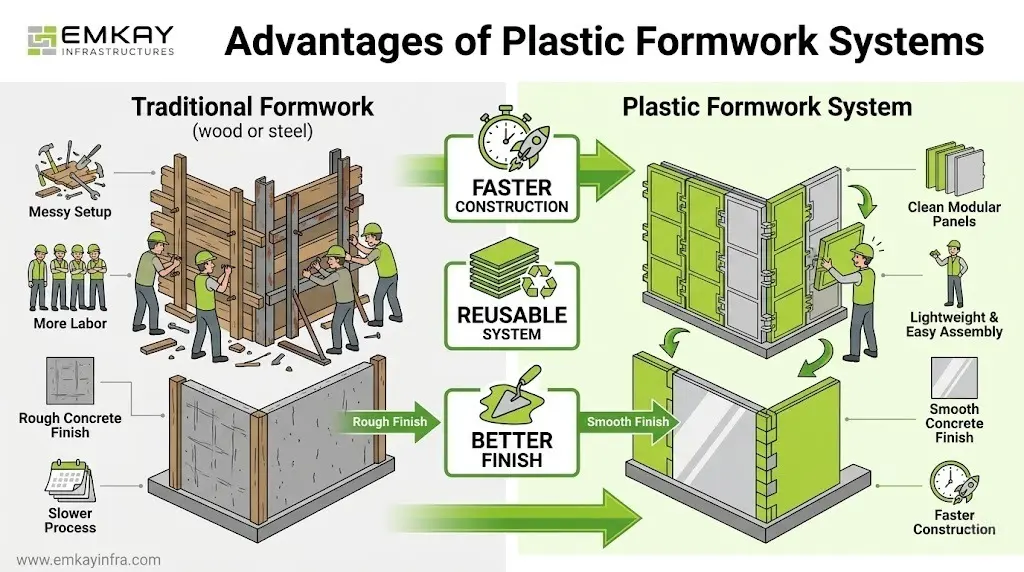
These characteristics make them an economical choice for projects requiring repetitive formwork applications.
How Plastic Formwork Systems Work
The operational process follows a straightforward, efficient methodology:
- Workers connect panels using integrated locking mechanisms
- Teams verify proper alignment to maintain precise dimensions
- Contractors pour concrete into the assembled mold
- After adequate curing time, workers carefully remove the panels
- Staff clean the panels thoroughly for the next application cycle
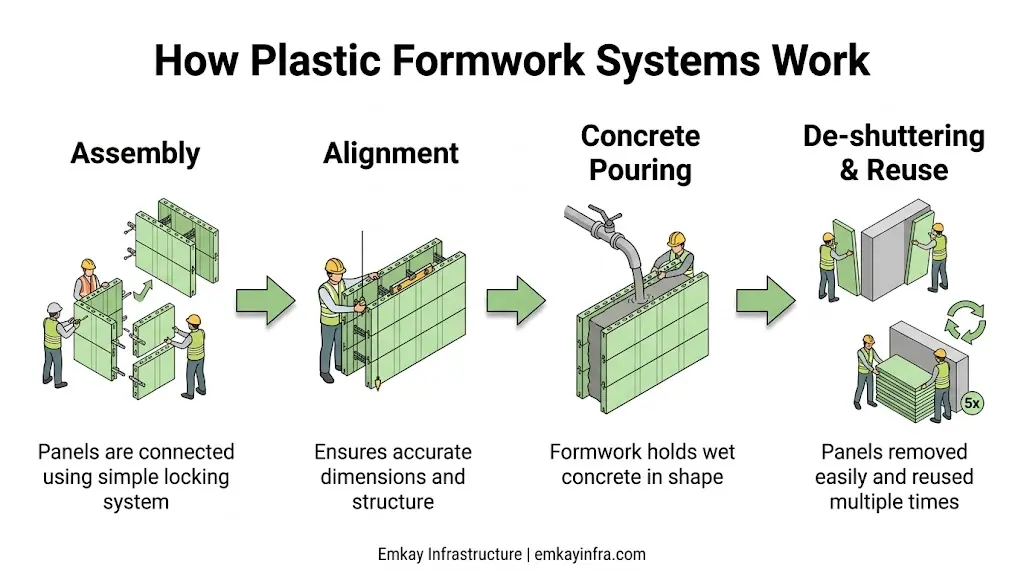
Construction teams repeat this process across different structural components.
Common Applications Include:
- Load-bearing walls
- Vertical columns
- Horizontal slabs
- Structural beams
The modular design allows teams to adapt configurations for various shapes and dimensions, making it suitable for monolithic construction techniques.
Why Builders Choose Plastic Formwork Systems
1. Long-Term Cost Efficiency
Although initial investment exceeds traditional options, the reusability factor transforms economics:
- Material expenses decrease with each project cycle
- Minimal wastage protects your budget
- Extended service life delivers substantial savings
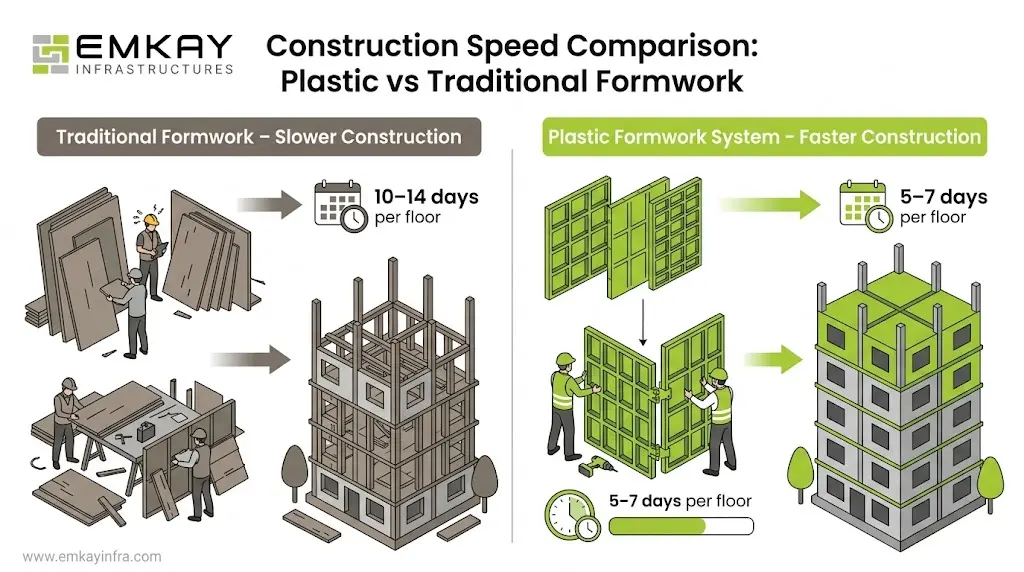
2. Accelerated Construction Timelines
Lightweight panels streamline handling and installation processes. As a result, project schedules compress significantly.
Compared to timber formwork:
- Installation time drops by 40-50%
- Removal becomes quicker and safer
- Overall, project delivery speeds up noticeably
This advantage proves invaluable for large-scale developments with tight deadlines.
3. Superior Concrete Surface Quality
The smooth panel surface produces uniform, high-quality concrete finishes.
Benefits include:
- Reduced plastering requirements
- Lower finishing material costs
- Enhanced aesthetic appeal
Many projects eliminate plastering entirely, saving both time and money.
4. Lower Labor Dependencies
The intuitive design simplifies the learning curve for construction crews.
Consequently:
- Projects require fewer specialized workers
- Work quality remains consistent
- Site supervision becomes more manageable
This addresses the skilled labor shortage many Indian construction firms face.
5. Environmentally Responsible Building
These solutions support sustainable construction practices by:
- Eliminating dependence on timber resources
- Drastically reducing site waste
- Promoting circular economy principles through reuse
The Indian Green Building Council recognizes reusable formwork as a sustainable construction practice that contributes to green building certifications.
Plastic Formwork vs Traditional Methods: Detailed Comparison
| Feature | Plastic Shuttering | Timber Formwork | Steel Formwork |
|---|---|---|---|
| Reuse Potential | 100+ cycles | 5-10 cycles | 50+ cycles |
| Weight | Lightweight | Heavy | Very Heavy |
| Surface Finish | Smooth | Rough texture | Smooth |
| Waste Generation | Minimal | High | Moderate |
| Transport Cost | Low | Moderate | High |
| Maintenance | Minimal | High | Moderate |
| Weather Resistance | Excellent | Poor | Rust concerns |
Key Comparisons:
Versus Timber:
- Plastic eliminates wood waste and deforestation concerns
- No warping, splitting, or moisture damage
- Consistent dimensions across multiple uses
Versus Steel:
- Easier transportation and handling on-site
- No corrosion or rust deterioration
- Greater flexibility for design modifications
- However, steel remains preferable for heavy-duty industrial applications
Applications Across Project Types
Construction professionals deploy plastic shuttering across diverse project categories.
Residential Developments
- Independent houses and villas
- Multi-story apartment complexes
- Gated community projects
- Affordable housing schemes
Commercial Construction
- Corporate office buildings
- Retail showrooms and malls
- Shopping complexes
- Hotel developments
Infrastructure Projects
- Foundation structures
- Load-bearing columns
- Drainage and sewage systems
- Boundary and compound walls
- Water tanks and reservoirs
The adaptability makes these systems suitable for projects of any scale, from individual homes to large infrastructure developments.
Understanding Monolithic Construction Benefits
Monolithic construction involves casting all structural elements—walls, slabs, and beams—in a single continuous pour.
Advantages Include:
- Enhanced structural integrity
- Reduced joint vulnerabilities
- Improved long-term durability
- Significantly faster construction
Plastic shuttering panels excel in monolithic applications because they create tight joints and maintain precise dimensional accuracy throughout the casting process. This technique has gained popularity for its earthquake resistance and structural strength, particularly relevant for India’s seismic zones.
Common Mistakes to Avoid
Protect your investment and ensure optimal performance by avoiding these errors:
❌ Improper panel alignment leads to dimensional inaccuracies
❌ Inadequate cleaning after use reduces panel lifespan
❌ Rough handling causes cracks and damage
❌ Incorrect concrete pouring techniques create pressure issues
❌ Insufficient bracing results in formwork failure
Addressing these concerns maintains durability and ensures consistent performance across multiple construction cycles.
Maintenance Guidelines for Extended Lifespan
Maximize your formwork investment with proper care:
✓ Clean panels thoroughly after every application
✓ Store in covered, dry locations away from direct sunlight
✓ Handle carefully to prevent impact damage
✓ Conduct regular inspections for cracks or wear
✓ Maintain inventory records to track panel usage
Following these practices, contractors typically achieve 100+ reuse cycles, substantially improving project economics.
Selecting the Right System for Your Project
Before making your decision, evaluate these critical factors:
- Project scale and complexity determine panel quantities
- Budget allocation for initial investment and long-term value
- Construction timeline and schedule requirements
- Labor availability and skill levels
- Structural requirements and load considerations
The Future of Construction Formwork
Several market forces drive the increasing adoption of plastic shuttering:
- Rising labor costs make efficient systems more attractive
- Time-sensitive projects demand faster construction methods
- Sustainability mandates require eco-friendly solutions
- Technology advancement improves material strength and durability
- Government initiatives promote modern building techniques
Industry analysts project that plastic formwork will capture an increasingly larger market share as construction practices modernize throughout India. According to Construction Week India, the Indian formwork market is expected to grow at 8.2% CAGR through 2028.
Final Thoughts
Plastic shuttering represents more than an alternative to conventional methods—it embodies a smarter, more efficient approach to modern construction.
These systems deliver:
- ✅ Accelerated project completion
- ✅ Reduced overall costs
- ✅ Enhanced construction quality
- ✅ Environmental sustainability
For contemporary construction projects across India, plastic formwork has evolved from an experimental option to a proven, reliable solution that addresses multiple industry challenges simultaneously.
Whether you’re planning a residential development, commercial complex, or infrastructure project, these innovative systems deserve serious consideration for their tangible benefits and long-term value.
Related Resources
📖 Read more: Shear Wall vs Normal Wall – Structural Differences
📖 Learn about: What Are the Advantages of a Shear Wall
📞 Ready to Build Safer, Stronger, Faster?
Planning a residential, commercial, or industrial project in Tamil Nadu?
Get expert structural engineering guidance to choose the optimal construction system for your specific requirements.
👉 Book Your Free Structural Consultation Today: 9345552010
What You’ll Receive:
✓ Comprehensive structural consultation
✓ Detailed site assessment guidance
✓ Customized structural system recommendations
✓ Accurate cost and timeline projections
✓ Material selection advisory
Written by the Structural Engineering Team – Emkay Infrastructure
Specialists in shear wall construction, structural design, and RCC building solutions
Serving Coimbatore and across Tamil Nadu
Frequently Asked Questions About Plastic Formwork Systems
Why is plastic formwork better than timber or steel?
Plastic formwork is lightweight, reusable, and gives a smoother finish. It reduces labor effort, minimizes waste, and doesn’t warp or rust like timber or steel, making it more reliable for repeated use.
How many times can plastic formwork be reused?
Most plastic formwork systems can be reused 100+ times with proper maintenance. This high reuse cycle reduces overall project costs and makes it a cost-effective long-term investment.
Where is plastic formwork commonly used?
It is widely used in walls, columns, slabs, beams, and foundations. It’s suitable for residential buildings, commercial projects, and infrastructure works where repetitive structures are required.
How does plastic formwork save construction time?
Its modular and lightweight design allows quick assembly and removal. This can reduce installation time by up to 40–50%, helping projects finish faster without compromising quality.
What are the key advantages of plastic formwork systems?
The main benefits include faster construction, lower labor dependency, smooth concrete finish, and reduced material waste. It also supports sustainable building practices by avoiding timber use.
Is plastic formwork suitable for small projects?
Yes, it works well for both small and large projects. For small residential builds, it improves speed and finish quality, especially when similar structural elements are repeated.
What mistakes should be avoided when using plastic formwork?
Avoid poor alignment, rough handling, and improper cleaning. These can damage panels and reduce lifespan. Proper setup and care ensure consistent performance and better results.
How do you maintain plastic formwork for long use?
Clean panels after each use, store them in a dry place, and handle them carefully. Regular inspection helps maintain durability and ensures you get maximum reuse cycles.