
Introduction
The construction industry in India is evolving rapidly, driven by the need for faster execution, cost control, and consistent structural quality. Traditional shuttering methods like timber and steel are increasingly being replaced by advanced plastic formwork systems.
Today, many plastic formwork manufacturers in India offer modular solutions that improve construction speed, reduce labour dependency, and deliver better finishing quality.
However, not all plastic formwork suppliers provide the same level of quality, durability, or technical support. Choosing the wrong supplier can increase project cost and reduce efficiency.
For builders, contractors, and developers, selecting the right plastic formwork manufacturers directly impacts:
- Project timeline
- Labour efficiency
- Structural accuracy
- Long-term cost
This guide explains how to evaluate and choose the best plastic formwork manufacturers in India, using real technical benchmarks and practical decision criteria.
What is Plastic Formwork?
Plastic formwork is a reusable, modular shuttering system made from engineered plastic panels used to cast concrete elements such as walls, slabs, beams, and columns.
Modern plastic shuttering materials offer:
- Lightweight handling
- Faster installation
- High reusability (80–120 cycles)
- Water and corrosion resistance
Because of these advantages, many builders are moving away from timber and partnering with reliable plastic formwork suppliers to improve project efficiency.
PP vs PVC – Understanding the Material Difference
One of the most critical factors when choosing plastic formwork manufacturers in India is the material used.
Most high-quality systems are made from Polypropylene (PP) rather than PVC.
Why PP is Preferred:
- Withstands high temperatures (up to 60°C+)
- Better resistance to concrete pressure
- Does not warp or crack easily
- Higher reuse cycles
| Property | PP (Polypropylene) | PVC |
| Heat resistance | High | Low |
| Strength | High | Medium |
| Reusability | 100+ cycles | 40–60 cycles |
| Durability | Excellent | Moderate |
👉 For Indian site conditions, PP-based plastic formwork is the most reliable choice.
Top Things to Look for in Plastic Formwork Manufacturers in India
Instead of focusing on brand names, contractors should evaluate suppliers based on these critical factors:
1. Material Quality & Load Capacity
The performance of plastic formwork depends on its structural strength.
Key benchmarks:
- Load capacity: up to 50–60 kN/m²
- Panel thickness: 12–18 mm
- High impact resistance
A good manufacturer should provide test data and technical specifications.
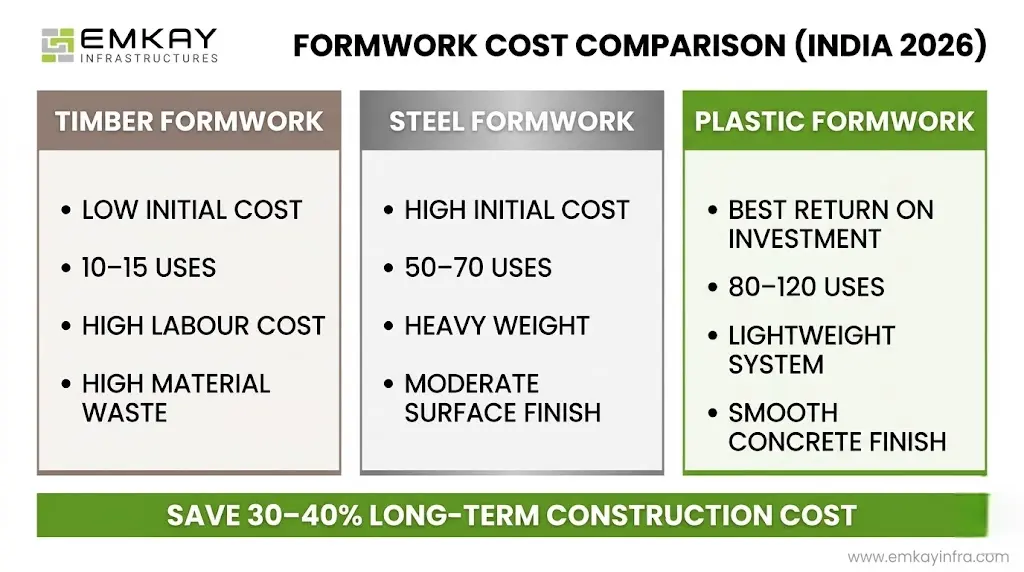
2. Reusability & Long-Term ROI
The biggest advantage of working with reliable plastic formwork suppliers is cost efficiency over multiple uses.
| Material | Cost per Panel | Uses | Cost per Use |
| Timber | ₹700 | 10–15 | ₹50+ |
| Steel | ₹2500 | 50–70 | ₹35–50 |
| Plastic | ₹1500–₹2500 | 80–120 | ₹20–30 |
👉 Plastic formwork offers the best return on investment.
3. Pricing Transparency (Important for B2B Buyers)
In India, plastic formwork is typically sold:
- Per panel (e.g., ₹1,500–₹2,500 per 600×600 panel)
- OR
- Per square meter (~₹5,500–₹8,800/sqm depending on system quality)
👉 Always confirm the unit before comparing suppliers.
4. Standard Sizes & Compatibility
Reliable plastic formwork manufacturers provide standard panel sizes:
- 600 × 600 mm
- 1200 × 600 mm
- 1200 × 1200 mm
Standardization improves:
- Speed
- Accuracy
- Replacement flexibility
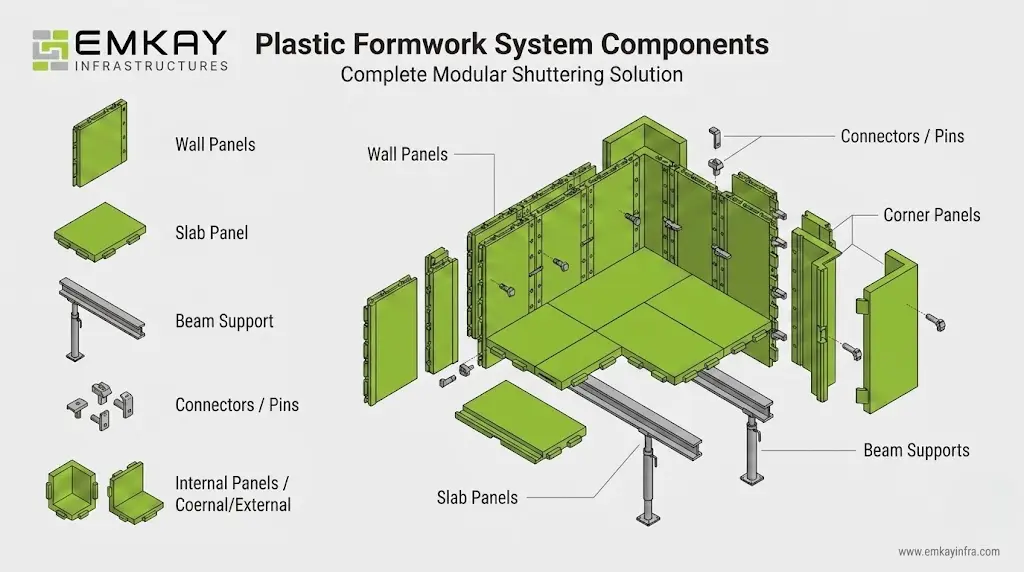
5. Complete System Availability
Top plastic formwork suppliers provide a full modular system:
- Wall panels
- Slab panels
- Beam supports
- Connectors and pins
Incomplete systems increase site delays.
6. Labour Efficiency & Construction Speed
Plastic formwork significantly improves productivity:
- 30–40% faster construction
- Reduced labour dependency
- Faster cycle time per floor
7. Technical Support & Training
Professional manufacturers provide:
- On-site training
- Installation guidance
- Technical consultation
This ensures correct usage and a longer lifespan.
8. Supplier Experience & Reliability
Before choosing a supplier, evaluate:
- Project experience
- Client feedback
- Delivery capability
Experienced plastic formwork manufacturers in India reduce risk and improve execution quality.
Technical Benchmarks You Should Check
Load Capacity
- Static load: 50–60 kN/m²
- Dynamic load: 40–45 kN/m²
Material Properties (PP)
- Density: ~0.90 g/cm³
- Tensile strength: ≥35 MPa
- High flexural strength
Realistic Performance Scenario (Based on Industry Usage)
In a typical mid-rise apartment project (6–10 floors):
- Construction speed improves by ~30%
- Reuse cycles reach 80–100 uses
- Labour cost reduces significantly
- Cost per use drops below ₹25
👉 These results depend on proper handling and system quality.
Important Engineering Reference (IS 456:2000)
Instead of general load factors, contractors should focus on:
👉 IS 456:2000 – Clause 11.3 (Formwork Removal)
This clause states:
- Formwork should only be removed after the concrete has gained sufficient strength
- Concrete must safely support loads during removal
👉 This directly impacts formwork reuse and safety.
Common Mistakes to Avoid
❌ Choosing based only on the lowest price
❌ Ignoring material quality (PP vs PVC)
❌ Not checking reuse cycles
❌ Buying incomplete systems
❌ No technical support
👉 These mistakes increase the total project cost.
Why Emkay Infra is a Trusted Choice
Among reliable plastic formwork manufacturers in India, Emkay Infra focuses on performance-driven systems suitable for Indian construction conditions.
Key Strengths:
✔ High-quality PP-based plastic formwork
✔ Designed for 100+ reuse cycles
✔ Complete modular system
✔ Technical support and site guidance
✔ Consistent performance across projects
Future of Plastic Formwork in India
The demand for plastic formwork manufacturers in India is increasing due to:
- Labour shortages
- Faster construction requirements
- Cost efficiency
- Sustainable construction practices
Plastic formwork is expected to become a standard solution in residential and commercial construction.
Related Resources
Explore more insights on plastic formwork, shuttering materials, and modern construction techniques in India:
- Plastic Formwork Systems: Benefits, Uses & Cost Guide
- Plastic Formwork vs Timber Formwork: Complete Comparison Guide
- Plastic Formwork vs Steel Formwork: Cost & Performance Comparison 2026
Conclusion
Choosing the right plastic formwork manufacturers in India is a strategic decision that affects cost, speed, and quality.
Instead of focusing only on price, evaluate:
- Material quality
- Technical specifications
- Reusability
- Supplier reliability
Working with experienced plastic formwork suppliers ensures better performance, faster execution, and long-term savings.
📞 Get Expert Guidance
Planning a project?
👉 Call: 9345552010
✔ Product consultation
✔ Technical support
✔ Project planning
Frequently Asked Questions (FAQs)
How many times can plastic formwork be reused?
High-quality Polypropylene (PP) plastic formwork can be reused between 80 to 120 times if handled correctly by site workers. In contrast, traditional plywood or timber usually lasts only 10 to 15 cycles. This high reusability makes plastic shuttering the most cost-effective option for mid-rise and high-rise projects.
Which is better for shuttering: PP or PVC plastic formwork?
PP (Polypropylene) is vastly superior to PVC. PP can withstand high temperatures (up to 60°C+), making it ideal for Indian weather. It also has a higher load-bearing capacity, doesn't warp or crack easily under concrete pressure, and offers over 100 reuse cycles, whereas PVC usually maxes out around 40–60 cycles.
Do we need to use shuttering oil with plastic formwork?
No, one of the biggest advantages of plastic formwork is that it does not require shuttering oil or releasing agents. Concrete does not stick to the engineered plastic surface. This not only saves money on chemicals but also speeds up the stripping process and results in a smooth, high-quality concrete finish.
What is the load-bearing capacity of modular plastic formwork?
Top-tier plastic formwork systems manufactured in India are designed to handle significant concrete pressure. A standard, high-quality PP panel (12–18 mm thick) typically has a static load capacity of 50–60 kN/m² and a dynamic load capacity of 40–45 kN/m², making it perfectly safe for casting slabs, columns, and shear walls.
Is plastic formwork faster to install than traditional steel or timber?
Yes. Because plastic formwork is extremely lightweight and uses a simple modular pin-and-wedge locking system, it reduces reliance on skilled labor and heavy lifting equipment. Contractors typically see a 30% to 40% improvement in construction speed and faster floor-to-floor cycle times.
How do I verify the reliability of a plastic formwork supplier in India?
Do not base your decision solely on the lowest price. To verify a manufacturer, check their material specifications (ensure it is PP, not PVC), ask for load capacity test reports, and confirm they offer a complete modular system (panels, beam supports, connectors). Reliable suppliers like Emkay Infra will also provide on-site training and technical support to ensure your team uses the system correctly.