
Introduction
If you’ve spent any time managing a construction site in India, you already know the headache: timber formwork warping after just a handful of pours, carpenters spending hours on setup, and plastering costs eating right into your margins. Understanding the advantages and disadvantages of plastic formwork is, therefore, essential before you make any major investment in a new shuttering system. Whether you’re putting up a commercial complex or a multi-tower housing society, relying on the wrong system is a surefire way to bleed both time and money.
That’s exactly why plastic formwork has become such a massive talking point lately. Across large residential and commercial sites, it’s promising rapid cycle times, glass-like finishes, and a serious drop in long-term expenses. However, let’s be real — it’s not a magic bullet for every single project.
In this guide, we’re cutting through the marketing noise to give you an honest look at the plastic formwork pros and cons. If you’re a developer or contractor trying to figure out whether this system is worth the investment, here is everything you need to know.
Want a quick primer first? Check out our complete breakdown of plastic formwork systems and applications.
1. What Exactly Is Plastic Formwork?
At its core, plastic formwork is a modular shuttering system made from tough, engineering-grade plastics like high-density polypropylene (PP). Think of it like a heavy-duty, interlocking puzzle. You use panels, props, and connectors to create the mould, pour your concrete, let it set, and then strip, clean, and reuse the panels.
We typically use these panels for:
- Walls (both residential and heavy load-bearing)
- Slabs (flat slabs and beam-slab setups)
- Columns (circular and rectangular)
- Beams * Staircases and lift cores. The whole system is built for repetition. The more identical pours you have, the cheaper the system gets per use. It’s a massive reason why contractors handling huge blocks of identical units under government schemes like the Pradhan Mantri Awas Yojana (PMAY) swear by it.
The Quick Numbers:
- Lifespan: 120+ uses per panel (if you treat them right)
- Speed: 30–40% faster than traditional timber
- Price: Starts around ₹5,500 per sq.m in India
- Finishing: Zero plastering needed on most surfaces
2. Pros and Cons at a Glance
The Good:
- ✅ 80–120+ reuse cycles
- ✅ 30–40% faster floor cycles
- ✅ Super lightweight (no crane required)
- ✅ Leaves a smooth, Class-A concrete finish
- ✅ Shrugs off rain, humidity, and standing water
- ✅ Almost zero site waste
- ✅ Exact dimensional consistency every single time
The Bad:
- ❌ Takes a bigger bite out of your initial budget
- ❌ Struggles with complex, custom architectural shapes
- ❌ You can’t just cut it to size on-site like wood
- ❌ Needs a crew that actually cares about proper handling and storage
- ❌ There’s a slight learning curve for traditional carpenters
3. The 7 Biggest Advantages of Plastic Formwork
1. High Reusability (Where You Make Your Money Back)
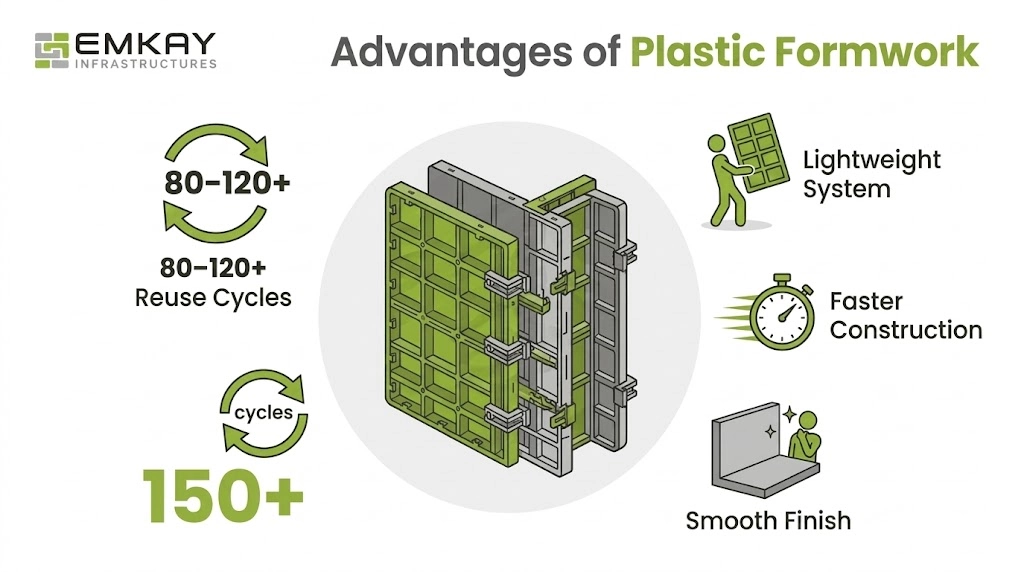
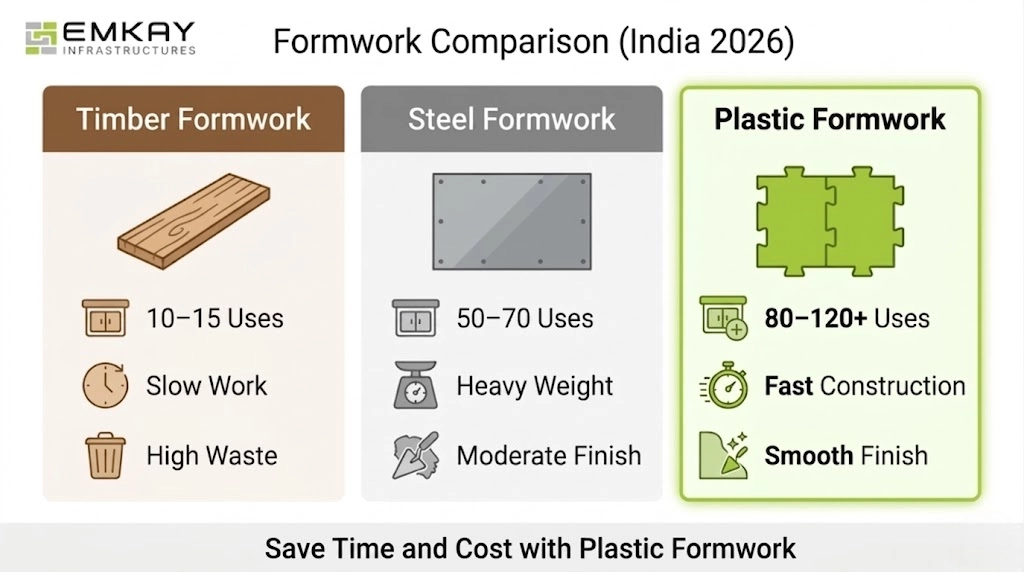
Timber might give you 10 to 15 pours before it turns into scrap. Steel will comfortably get you to 50 or 70. But high-quality plastic panels? You’re easily looking at 80 to 120+ cycles if your crew takes care of them.
If you are building a 20-story tower with the same floor plate all the way up, this drops your cost-per-pour to the floor. The panels don’t soak up water, they don’t swell, and they stay perfectly square.
2. Faster Floor Cycle Times
Plastic systems use a simple clip-and-lock mechanism. Once your crew gets the hang of it, they will fly through setup and stripping. We regularly see projects shave 30–40% off their cycle time per floor. Quicker floors mean you hand over the project sooner, keeping your overheads and financing costs tightly under control.
3. Crane-Free Handling
Moving steel formwork requires heavy machinery. Plastic panels are light enough that a single worker can grab one and walk it across the site. This instantly cuts down your crane hire and fuel costs, making it a lifesaver for tight urban plots where heavy equipment just isn’t practical.
4. The Concrete Finish is Flawless
Because the polypropylene is completely smooth and non-porous, the concrete comes out looking like glass. In a lot of cases, you can skip plastering altogether. When you multiply the cost of plaster, sand, and the labour required to apply it across a whole high-rise, skipping that step saves a fortune.
5. Built for Indian Weather
Monsoons absolutely destroy timber. Polypropylene doesn’t care if it’s sitting in a puddle, baking in 40-degree heat, or covered in wet concrete. It’s also completely immune to chemical release agents and admixtures.
6. Better for Modern Structural Techniques
When you are moving away from basic brick-and-mortar and stepping up to highly durable, load-bearing designs like shear wall construction, precise pouring is non-negotiable. Plastic formwork locks together perfectly, holding the exact tolerances needed for these advanced structural walls without bowing under pressure.
7. Zero Scrap Waste
Walk around a site using timber, and you’ll see piles of splintered off-cuts everywhere. Plastic generates virtually zero waste. Plus, at the end of the project, the panels can actually be recycled.
4. The 5 Disadvantages You Need to Know
1. The Upfront Cost is Heavy
This is the main reason smaller contractors hesitate. A full system (panels, props, and connectors) will set you back about ₹5,500 to ₹8,000 per square metre. If you are only building a single custom villa, you will never get that money back. Plastic only makes financial sense when you can milk it for dozens of repetitive cycles.
2. It Hates Custom Shapes
Got a project with curved walls, sweeping organic beams, or intricate architectural details? Stick to timber. Plastic is rigid and comes in fixed factory sizes. It excels at right angles and standard grids, not bespoke design.
3. No On-Site Hacking
If a timber board is two inches too long, a carpenter just grabs a saw. You cannot do that with plastic panels without ruining them. Your formwork layout has to be flawlessly planned before the materials hit the site.
4. Your Crew Has to Respect the Gear
Polypropylene is tough, but it’s not invincible. If your site team is throwing panels off the second floor, leaving them scattered in the sun for months, or prying them off walls with metal crowbars, they will break. You have to enforce strict cleaning and storage habits.
5. The First Week is Slow
If your bar-benders and carpenters have only ever used ply and batten, they are going to grumble for the first few days. The prop spacing, the locking clips, and the stripping sequence are all different. Expect the first pour to be slow while they figure it out.
5. Plastic vs. Timber vs. Steel: The Ultimate Breakdown
| Feature | Plastic Formwork | Timber Formwork | Steel Formwork |
| Reuse Cycles | 80–120+ uses | 10–15 uses | 50–70 uses |
| Weight | Lightweight | Lightweight | Very Heavy |
| Initial Cost | Medium to High | Low | Very High |
| Long-Term Cost | Low (if reused) | High | Low–Medium |
| Speed | Fast | Slow | Medium |
| Concrete Finish | Smooth (No plaster) | Rough | Good |
| On-Site Tweaks | Very Limited | High | Zero |
| Weather Risk | None | High (Rot/Warp) | Medium (Rust) |
Need a deeper dive? Read our full side-by-side comparison of Plastic Formwork vs. Timber Formwork.
6. When to Go Plastic (and When to Walk Away)
Do Use Plastic If:
- You’re building a multi-story apartment block with identical floor plates.
- You’re doing mass housing where hundreds of units share the same layout.
- Your site has a tight deadline, and you need to cut floor cycle times.
- You want to eliminate the cost of interior wall plastering.
Stick to Timber/Alternatives If:
- You’re building a custom, one-off home.
- The architecture involves complex curves or irregular geometries.
- You’re a small contractor without the cash flow to buy the system outright (though renting is always an option!).
7. Let’s Talk ROI: Is It Actually Cheaper?
Contractors look at the initial invoice and balk. But formwork should be measured by cost-per-use, not the purchase price.
Imagine a 20-floor building needing 500 sq.m of shuttering:
| Cost Factor | Timber Formwork | Plastic Formwork |
| Initial Buy-in | ₹8 Lakh | ₹28 Lakh |
| Repairs / Replacements | ₹16 Lakh+ (constant buying) | Minimal |
| Plastering Costs | High | Saved entirely (approx ₹5 Lakh) |
| Labour Speed | Slower | Faster |
| Net Result | Bleeding cash by floor 10 | Saving ₹10–18 Lakh by floor 20 |
Once you cross that 10-to-15 reuse threshold, plastic formwork pays for itself and starts actively saving you money.
See the exact math: Read our complete Formwork Systems ROI Guide.
8. Is It Better for the Environment?
Sustainability is finally becoming a real priority in Indian construction, especially with the push for Indian Green Building Council (IGBC) certifications.
Plastic actually wins out here if managed right. A single plastic panel replaces the need for chopping down 8 to 10 sets of timber over its lifespan. There are no toxic chemical treatments involved, and you aren’t sending truckloads of splintered wood to the landfill every month. Just make sure you are working with a supplier who takes the panels back for recycling once they finally wear out.
9. The Bottom Line
Plastic formwork isn’t just a different material; it changes how your site operates. Yes, the initial price tag requires a bit of deep breathing, and your carpenters will need a few days to adjust. But if you are working on a repetitive project—like an apartment block or mass housing—sticking to timber is actively costing you money.
If speed, clean finishes, and lowering your long-term site costs are the goals for your 2026 projects, it’s time to seriously look at making the switch.
Related Resources
📖 Read more: How to Choose the Best Plastic Formwork Manufacturers in India (2026 Complete Guide)
📖 Compare: Plastic Formwork vs Steel Formwork: Complete Cost & Performance Comparison 2026
📖 Learn about: Plastic Formwork vs Timber Formwork: Which Is Better for Your Construction Project?
📖 Explore: Plastic Formwork Systems: Complete Guide to Modern Construction in India
Ready to upgrade your site?
Let’s figure out if this system makes financial sense for your exact floor plan. Our team will run the numbers and give you a transparent cost-per-use breakdown.
📞 Call us: 93455 52010
🌐 Explore our setups: https://emkayinfra.com/plastic-formwork/
📍 Get a Custom Quote: Contact Emkay Infra