Shear Wall Construction for Apartments: Benefits, Cost & Why It’s the Best Choice in India
More than 59% of India falls under seismic zones III, IV, and V — regions where buildings face real, measurable earthquake risk. For anyone building or buying an apartment in these zones, structural design is not a technical footnote. It is the difference between a building that survives a seismic event and one that does not.
Shear wall construction for flats has become one of the most trusted structural systems in India, precisely for this reason. It delivers earthquake resistance, reduces building sway, speeds up construction timelines, and holds up better over the lifetime of the building than traditional beam-column frame systems.
This guide covers everything you need to know — how shear walls work, their benefits, cost breakdown, IS code compliance, and how they compare to conventional frame structures — so you can make an informed decision for your apartment project.
What Is Shear Wall Construction?
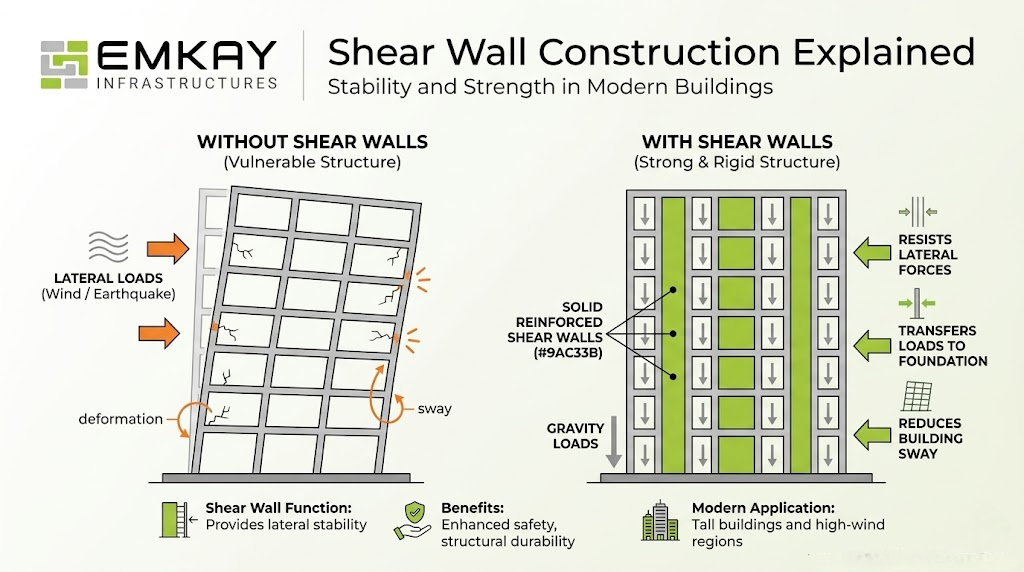
A shear wall is a vertical structural element made of Reinforced Cement Concrete (RCC) that is designed to resist lateral forces — primarily those caused by earthquakes and wind loads. Unlike traditional columns and beams, which carry mostly vertical loads, shear walls are specifically engineered to absorb and transfer horizontal forces safely into the foundation.
In an apartment building, shear walls are typically located at:
Lift core walls — the central shaft around lifts
Staircase enclosures — which naturally suit rigid wall placement
Perimeter structural zones — for buildings with higher lateral load demands
Symmetrical internal positions — to prevent torsional (twisting) stress during earthquakes
The walls are reinforced with steel bars (as per IS 13920:2016 and IS 456:2000) and poured with high-grade concrete, creating a rigid, continuous load path from the roof all the way down to the foundation.
In simple terms: shear walls turn an apartment building’s vulnerable points into its strongest ones.
How Do Shear Walls Resist Earthquakes?
When an earthquake strikes, the ground moves horizontally. This creates lateral (sideways) forces that travel upward through a building’s structure. In a conventional frame structure, these forces are absorbed by beams and columns — elements that are primarily designed for vertical loads and often perform poorly under repeated lateral stress.
Shear walls work differently. Their large surface area, rigid concrete composition, and steel reinforcement allow them to:
Absorb seismic energy before it can deform the building’s frame
Distribute lateral forces evenly across multiple structural elements
Prevent inter-storey drift — the dangerous sideways shift between floors during an earthquake
Maintain ductility — controlled flexibility that allows the structure to bend slightly without collapsing
This is why IS 13920:2016 — India’s code for ductile detailing of RCC structures — mandates specific shear wall design requirements for buildings in seismic zones III, IV, and V. Buildings designed to this code perform significantly better in real earthquake events compared to those built only to minimum load-bearing standards.
Key Benefits of Shear Wall Construction for Apartments
1. Significantly Higher Structural Strength
Shear walls dramatically increase the overall stiffness of an apartment building. This is especially important for buildings taller than G+7, where lateral loads become a dominant structural concern. By acting as a rigid spine within the building, shear walls prevent deformation under load and ensure long-term structural integrity.
2. Proven Earthquake Resistance
For apartments in seismic zones III, IV, and V — which cover cities like Mumbai, Delhi, Chennai, Pune, Ahmedabad, and much of Northeast India — earthquake-resistant design is both a safety necessity and a regulatory requirement. Shear wall systems, when designed per IS 13920:2016, provide ductile behaviour, meaning the structure can absorb energy without sudden catastrophic failure.
3. Efficient Lateral Load Distribution
A lateral load-bearing wall system, like shear walls, distributes wind and seismic forces across multiple planes rather than concentrating them on individual columns. This reduces stress on each structural element, extends the building’s service life, and lowers the risk of localised failure.
4. Reduced Building Sway — Up to 40–60%
Tall residential buildings experience sway due to wind pressure, which causes discomfort for occupants and long-term fatigue in structural joints. Shear walls reduce lateral sway by 40–60% compared to equivalent frame structures. This translates to a more comfortable living environment and less maintenance over time.
5. Faster Construction with Modern Formwork
When shear wall construction is combined with Milan (aluminium) formwork or plastic formwork systems, floor cycle times drop significantly. Repetitive floor layouts — typical in apartment blocks — are ideal for this combination. Developers can achieve one floor per 4–7 days in optimised setups, compared to 10–15 days with conventional systems.
This speed advantage reduces financing costs, allows earlier delivery, and improves project cash flow.
6. Lower Long-Term Maintenance
Because shear walls reduce structural movement and distribute loads more evenly, apartments built with this system experience less cracking, settling, and joint degradation over time. For both developers and homebuyers, this means lower repair bills across the building’s 50–75 year design life.
7. More Usable Floor Space
In a frame structure, closely spaced columns interrupt interior layouts. Shear walls, placed strategically at cores and perimeters, allow for larger, column-free floor plates — giving architects and buyers more flexibility in unit design.
Shear Wall Construction vs Frame Structure: Which Is Better?
Feature
Shear Wall Structure
Frame Structure
Lateral Load Resistance
Very High
Moderate
Earthquake Safety
Excellent (IS 13920 compliant)
Average
Suitable Building Height
G+7 and above
Up to G+4
Construction Speed
Faster (with Milan/plastic formwork)
Slower
Column Dependency
Low
High
Usable Floor Space
More open layouts
Interrupted by columns
Long-Term Maintenance
Lower
Higher
IS Code Suitability (Seismic Zones III–V)
Strongly Recommended
Limited for high-rises
For apartment projects above four floors in any Indian seismic zone, shear wall construction is the structurally superior choice. Frame structures remain relevant for smaller residential buildings (G+1 to G+3) and low-seismic-risk areas.
Shear Wall Construction in the Indian Regulatory Context
India’s building standards strongly support shear wall adoption for multi-storey residential construction:
IS 13920:2016 — Ductile detailing of RCC structures subject to seismic forces. Mandates specific reinforcement patterns, wall thickness, and connection detailing for shear walls in earthquake zones.
IS 456:2000 — Code of practice for plain and reinforced concrete. Governs concrete mix design and structural member sizing.
National Building Code (NBC) 2016 — Provides comprehensive guidelines on structural safety for residential buildings, including requirements for lateral load resistance systems.
NDMA Seismic Zone Guidelines — The National Disaster Management Authority classifies over half of India’s land area in high to very high seismic hazard zones, making lateral load-resistant design a practical necessity.
Developers using shear wall systems compliant with these codes are better positioned for RERA approvals, structural audits, and long-term occupancy certificates.
Shear Wall Thickness and Placement: What You Should Know
For apartment buildings in India, shear walls are typically 200mm to 300mm thick, depending on:
Number of floors
Seismic zone classification
Structural engineer’s lateral load analysis
Concrete grade used (typically M25 to M40)
Placement strategy matters as much as thickness. Poorly placed shear walls — asymmetric, offset, or concentrated on one side — create torsional imbalance, which can actually worsen a building’s earthquake response. Competent structural engineers place walls symmetrically along both the X and Y axes of the building plan to ensure uniform lateral resistance in all directions.
For high-rise apartments (G+15 and above), coupled shear wall systems — where two wall panels are connected by reinforced coupling beams — are often used to improve ductility and energy dissipation.
Step-by-Step Shear Wall Construction Process
Here is how a standard shear wall is constructed in an apartment project:
Structural Design & Drawing Approval — Structural engineer prepares wall layout, thickness, reinforcement schedule per IS codes. Drawings are submitted for local authority approval.
Excavation and Foundation Work — Foundation designed to carry shear wall loads, typically a raft or pile foundation for high-rises.
Reinforcement Placement — Vertical and horizontal steel bars are placed per IS 13920:2016 specifications, including boundary elements at wall ends.
Formwork Installation — Plastic formwork or Mivan aluminium panels are erected on both sides of the wall.
Concrete Pouring — High-grade concrete (M25–M40) is poured and vibrated to remove air pockets.
Curing — Walls are cured for a minimum of 7 days (ideally 28 days for full strength development).
De-shuttering & Quality Checks — Formwork is removed, and walls are inspected for honeycombing, alignment, and surface quality.
Repeat Cycle — For apartment blocks, this process repeats floor by floor, achieving fast cycle times with modern formwork.
Higher buildings need thicker, more reinforced walls
Concrete Grade
M30–M40 costs more than M25
Formwork Type
Coupled walls and irregular plans cost more to engineer
Structural Complexity
Coupled walls, irregular plans cost more to engineer
Approximate Cost Range: ₹900 – ₹1,300 per sq ft (structural cost only, varies by project and location)
While upfront costs are 8–12% higher than conventional frame structures, shear wall buildings typically recover this through:
Faster construction (lower financing and labour costs)
Reduced long-term maintenance
Higher resale value due to structural certification
Lower insurance premiums in some seismic zones
What Shear Wall Construction Means for Apartment Buyers
Buyers often focus on location, price per square foot, and amenities. But the structural system a building uses has long-term implications for your investment:
Earthquake safety — A shear wall building offers better protection in seismic events meaningfully
Fewer structural defects — Less cracking, settling, and joint failure over time
Quieter units — Concrete shear walls provide better sound insulation than frame systems
Higher resale value — Structurally certified buildings command a premium in the secondary market
Bank loan eligibility — Reputed banks and housing finance companies prefer structurally robust buildings for home loan approvals
When evaluating a new apartment, asking the developer about the structural system is not an overly technical question. It is a smart financial question.
When Is Shear Wall Construction Not the Right Choice?
Shear walls are not the ideal system for every project. They are generally not recommended for:
Independent houses (G+1, G+2) — The cost and engineering overhead outweigh the benefits
Low-rise buildings in seismic zone II — Frame structures are often adequate
Projects with highly irregular floor plans — Irregular shear wall layouts can create structural complications if not carefully engineered
Very tight budget projects with no high-rise requirement — Frame structures offer a more economical entry point
For any apartment project above four floors — especially in zones III, IV, or V — shear wall systems remain the structurally and economically sound choice.
Frequently Asked Questions About Shear Wall Construction for Apartments
Is shear wall construction suitable for apartment buildings in India?
Yes, shear wall construction is highly suitable — and increasingly the preferred standard — for apartment projects in India, particularly for buildings of G+7 and above. It provides superior resistance to earthquake and wind forces, reduces structural sway, and speeds up construction when combined with Mivan or plastic formwork. For buildings in seismic zones III, IV, and V, which cover most major Indian cities, shear wall systems are strongly recommended by structural engineers and align with IS 13920:2016 requirements.
How does shear wall construction compare to a frame structure?
Shear wall structures outperform frame structures in almost every category relevant to high-rise apartments: lateral load resistance, earthquake safety, construction speed, long-term durability, and usable floor space. Frame structures are adequate for smaller buildings (G+1 to G+3) in lower seismic zones, but for multi-storey apartment blocks, shear walls provide a higher level of structural performance at a cost difference that is largely recovered through savings in time and maintenance.
What is the cost of shear wall construction in India?
The structural cost of shear wall construction typically ranges from ₹900 to ₹1,300 per sq.ft, depending on project size, number of floors, concrete grade, and formwork type. While this is 8–12% higher than conventional frame construction upfront, the total project cost is often comparable or lower when you factor in faster floor cycles, reduced maintenance, and higher long-term property value.
Are shear walls safe during earthquakes?
Yes. Shear walls are specifically designed to resist seismic lateral forces. When detailed per IS 13920:2016, they provide ductile behaviour — meaning the structure absorbs earthquake energy progressively rather than failing suddenly. This makes shear wall buildings significantly safer than frame structures during moderate to severe earthquake events. Cities like Mumbai, Delhi, Pune, Chennai, and Kolkata — all in seismic zone III or higher — benefit substantially from this system.
How thick should shear walls be in apartment buildings?
In Indian apartment construction, shear walls are typically 200mm to 300mm thick, depending on the building height, seismic zone, and structural load analysis. Boundary elements at the ends of shear walls may require additional thickness and reinforcement. Your structural engineer will determine the exact specifications based on IS 13920:2016 and site-specific conditions.
Can shear walls replace columns in apartment buildings?
In many shear wall-based structural systems, the number of internal columns is significantly reduced or eliminated in certain zones. The shear walls take over the lateral load function, while remaining vertical loads are carried by the walls themselves and any necessary columns at key junctions. This creates more flexible, open floor layouts that are preferred by architects and apartment buyers alike.
What IS codes govern shear wall construction in India?
The two primary codes are IS 13920:2016 (ductile detailing of RCC structures subject to seismic forces) and IS 456:2000 (code of practice for plain and reinforced concrete). The National Building Code 2016 also provides broader structural safety guidelines. For projects in seismic zones III–V, compliance with IS 13920:2016 is essential and is typically required for building plan approvals.
What is the difference between a shear wall and a load-bearing wall?
Both resist vertical loads, but their primary functions differ. A load-bearing wall is designed mainly to carry the weight of the floors and the roof above it. A shear wall is specifically engineered to resist horizontal (lateral) forces from earthquakes and wind. In modern apartment construction, RCC shear walls often perform both functions simultaneously — carrying vertical loads while providing lateral resistance — making them a more structurally efficient system.
Shear wall construction has moved from being a specialised technique to the practical standard for apartment projects across India — and for good reason. In a country where the majority of population centres sit in moderate to high seismic zones, building without adequate lateral load resistance is a structural and financial risk that responsible developers and informed buyers are no longer willing to accept.
For developers, shear wall systems mean faster floor cycles, cleaner construction quality, and a product that can genuinely be marketed on structural merit. For buyers, it means an apartment built to withstand the forces that Indian geography demands — with lower maintenance, better acoustics, and a structure that will hold its value over decades.
If you’re planning an apartment project and want to determine the right structural system for your specific site, floor count, and budget, expert guidance at the design stage makes a significant difference in both safety outcomes and project economics.
📞 Ready to Build a Safer & Faster Apartment Project?
Planning a high-rise residential project in Tamil Nadu? Get expert guidance to integrate earthquake-resistant shear wall systems and speed up your construction timelines.
👉 Book Your Free Structural Consultation: 9345552010
What You’ll Receive: ✓ Earthquake-resistant design consultation (IS compliant) ✓ Cost & timeline comparison (Frame vs. Shear Wall) ✓ Fast floor cycle planning with modern formwork
Written by the Structural Engineering Team – Emkay Infrastructure Specialists in shear wall construction & structural design across Tamil Nadu.